
- All
- Product Name
- Product Keyword
- Product Model
- Product Summary
- Product Description
- Multi Field Search

Views: 0 Author: Site Editor Publish Time: 2026-11-25 Origin: Site


Fabric weight is the first number on nearly every knitwear specification, and the one most often negotiated, quoted, and disputed. A buyer comparing two quotations sees "180 GSM" and "200 GSM" and assumes a straightforward difference in substance. A knitter standing at a circular machine sees the same numbers as the output of a loop geometry that shifts with every adjustment of the cam, the feeder tension, and the yarn lot. The gap between those two readings is where most weight claims originate, and it is a gap in understanding rather than in manufacturing capability.
GSM in knitted fabric means grams per square metre: the mass of the fabric divided by its surface area, expressed in g/m². The technically correct term is mass per unit area, sometimes called areal mass. A 220 GSM single jersey holds 220 grams of yarn and finish in every square metre of fabric in the stated condition. Because that mass is the product of yarn count, loop length, and stitch density, GSM is not a fixed property to be discovered after knitting; it is a consequence of settings that a knitter chooses, and it can therefore be controlled within a defined tolerance rather than merely inspected and argued over at the end of the roll.
Understanding what the number measures comes first, and understanding which variables produce it comes second.
GSM stands for grams per square metre, and it quantifies how much material occupies a measured area of fabric. It is a ratio, not a rating: the calculation is specimen mass divided by specimen area, and the result says nothing on its own about thickness, density, warmth, durability, or quality. One square metre of a bulky open knit and one square metre of a fine compact knit can both weigh 300 grams while behaving as entirely different materials.
The distinction matters commercially because weight is used as a proxy for substance in negotiations. Two fabrics at the same GSM can differ in thickness by a factor of two, in air permeability by an order of magnitude, and in drape by the difference between a structured outer layer and a fluid one. Weight tells you how much yarn is present per unit area. Structure tells you how that yarn is arranged. Yarn quality tells you how it will behave after twenty washes.
For knits specifically, GSM is the practical unit because tubular fabric is sold by weight and cut by length. A converter who buys 500 kilograms of 180 GSM jersey knows, roughly, how many garments that mass will yield. Change the weight without changing anything else and the economics of the whole order shift, which is why the number carries so much commercial weight and so little mechanical meaning.
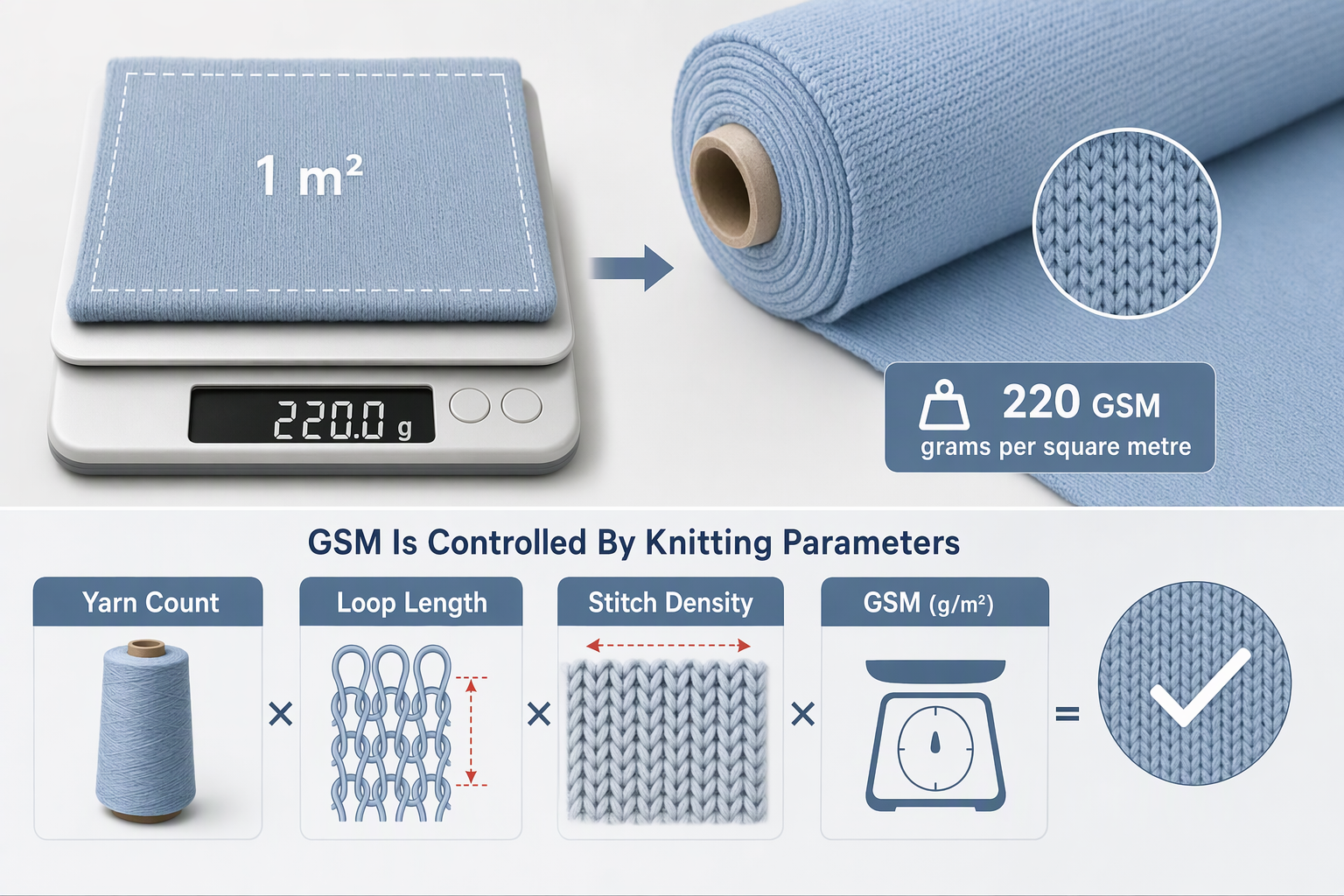
Cut a specimen of verified area, weigh it on a balance readable to 0.001 grams, and divide the mass in grams by the area in square metres. With the standard 100 cm² circular cutter, the arithmetic collapses to multiplying the specimen mass in grams by 100. A specimen weighing 2.35 grams therefore reports 235 g/m².
The full laboratory procedure is short but unforgiving of shortcuts:
Condition the fabric in the standard atmosphere defined by ISO 139, which specifies 20 ± 2 °C and 65 ± 4% relative humidity, until it reaches constant mass.
Lay the fabric flat without tension. Do not pull a curled edge straight to match a template.
Cut five specimens with a circular cutter of known area, taken from positions spread across the width and along the length.
Weigh each specimen individually on a calibrated balance and record to three decimal places.
Convert each mass to grams per square metre using the verified cutter area, not a remembered factor.
Report the mean, the range, and the coefficient of variation.
Cutter area determines the multiplier, and a worn cutter drifts. A die that has cut thousands of samples can creep above its nominal area, which quietly deflates every result calculated from it.
Specimen area | Multiplier to g/m² | Typical use |
100 cm² (113 mm diameter) | × 100 | Standard circular cutter, most knits |
50 cm² | × 200 | Narrow tubular or ribbed fabric |
200 cm² | × 50 | Coarse gauge, high-relief structures |
500 cm² | × 20 | Very open or unstable knits needing a larger sample |
One specimen describes one location. ASTM D3776 sets out four approved options for determining mass per unit area, and its small-swatch option explicitly limits the result to the sample tested rather than to the lot it came from. For lot acceptance, the sampling plan has to span the width, the length, and multiple rolls, because a mean within tolerance can conceal a feeder stripe or a side-to-side take-down difference.
Four errors account for most failed weight checks that later turn out to be laboratory artefacts rather than production faults. An unconditioned specimen straight off the machine can carry enough moisture to read high by several percent. A drifting balance introduces error invisible on a two-gram sample. A specimen cut from the roll end rather than the body misrepresents the run. And residual hygroscopic softener inflates the reading immediately after finishing.
Where the laboratory measures the result, the construction formula predicts it. For single jersey, weight can be estimated from stitch density, loop length, and yarn linear density:
GSM = CPI × WPI × 1550 × stitch length (mm) × yarn count (Tex) ÷ 1,000,000
The constant 1550 converts square inches to square metres. A relaxed single jersey at 50 courses per inch, 36 wales per inch, 2.8 mm loop length, and a 19.68 Tex cotton yarn gives roughly 154 g/m².
The formula is a cross-check, not a substitute for measurement. It assumes one loop per course per wale, which is true for fabric from single jersey machines and false for rib and interlock, where two needle beds carry loops. It also assumes a relaxed state; run it on greige fabric and it will understate the finished weight.
Parameter | Symbol | Typical range | How it is measured |
Courses per inch | CPI | 18 to 32 | Counting glass over 5 inches, then divide |
Wales per inch | WPI | 14 to 24 | Unravel 10 inches, count wales, divide |
Stitch length | SL | 2.6 to 3.4 mm | Unravel 100 loops, measure total length, divide |
Yarn count | Tex or Ne | 20s to 40s Ne for jersey | Wrap reel and balance, or from yarn supplier certificate |
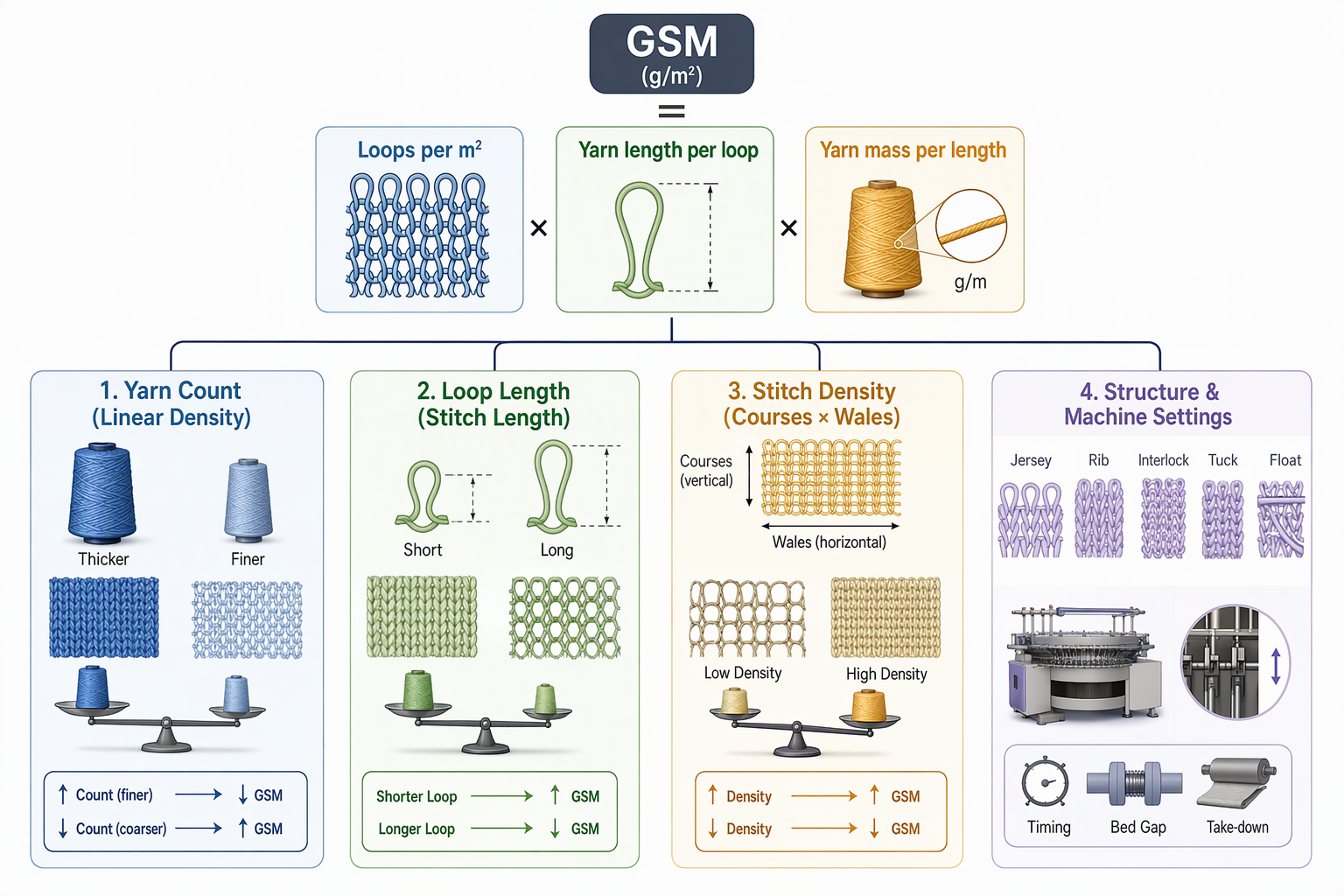
Mass per unit area is the product of three quantities: the number of loops occupying one square metre, the length of yarn each loop consumes, and the mass of that yarn per unit length. Every control lever on a knitting machine acts on one of these three, which is why weight responds predictably to a small number of settings and chaotically to everything else.
Hold that relationship in mind and the rest of the control problem becomes tractable. Increase loops per square metre and weight rises. Increase yarn length per loop and weight rises. Increase yarn linear density and weight rises. Change two at once in opposite directions and the net effect is frequently nothing, which is exactly how a mill can deliver the right number with the wrong fabric.
Yarn count is the fastest lever and the most expensive one to move, because it changes what you buy rather than how you run the machine. Substituting a finer count at the same loop length reduces weight roughly in proportion, opens the fabric, softens the hand, and lowers yarn cost per kilogram while raising it per metre. Counts are quoted in several systems, and Tex, Ne, and Denier are not interchangeable without conversion.
Loop length is the single most sensitive variable under the knitter's direct control. Shortening the loop packs more loops into the same area and raises GSM; lengthening it does the reverse, and does so faster than intuition suggests, because stitch density falls as loop length rises. The consequences travel together: a shorter loop narrows the fabric, increases shrinkage potential, firms the hand, and reduces production speed. There is no such thing as changing weight alone.
Courses per inch multiplied by wales per inch is the density term in the formula, and it is what separates a fabric that merely weighs the right amount from one that is actually built correctly. Machine gauge describes needle spacing, not the number of relaxed loops in a square metre. A 28-gauge machine can produce a loose fabric or a tight one depending on loop length, take-down, and relaxation. Gauge is a capability; density is a result.
Structure decides how much yarn the loop architecture places into the area. Plain jersey uses one yarn path per course. Rib draws yarn between two needle beds and produces a heavier, narrower fabric at the same loop length. Interlock, tuck, and float structures each allocate yarn differently, and a float-backed jacquard can add weight where the floats sit without a proportional change across the whole surface. On interlock and rib machines, knitting timing and the gap between the two beds introduce a source of variation that single jersey does not have.
Control means fixing loop length and yarn count, then accepting the weight that the construction produces. The three primary levers are stitch cam setting, yarn input tension, and yarn count. Cam setting and input tension adjust loop length in real time; yarn count is fixed at the lot level and cannot be corrected mid-run.
The hierarchy matters because the levers are not equivalent, and because they are the only three adjustments on circular knitting machines that change weight without changing what the product is.
Lever | Effect on GSM | Side effects | Priority |
Stitch cam setting | Strong, immediate | Width, shrinkage, hand, speed | Primary, adjusted per style |
Yarn input tension | Moderate, fast | Loop variation, needle wear, fabric width | Secondary, trimmed during running |
Yarn count | Strong, structural | Cost, hand, opacity, all downstream specs | Fixed at development |
Take-down tension | Weak to moderate | Width, spirality, surface | Correction only |
Machine speed | Weak, indirect | Density consistency, needle temperature | Not a weight control |
The working sequence is a closed loop rather than a single adjustment:
Knit a trial at the target loop length derived from the construction formula.
Relax the trial the way production will be relaxed, by washing, steaming, or both.
Condition and measure the relaxed sample.
Compare against target and back-calculate the loop length correction.
Adjust the cam, re-knit, and repeat until the relaxed weight sits at the centre of tolerance.
Weight is an outcome; loop length is a cause. A knitter who chases the weight number directly will eventually hit it by stretching the fabric, over-feeding the yarn, or narrowing the width, and will deliver a roll that passes the weight check while failing on width, shrinkage, and hand. Loop length is the variable that can be held to a target and audited on the machine, which makes it the correct control point and the correct thing to write into a purchase order alongside the weight.
Track the mean, the range, and the coefficient of variation per roll rather than a single pass or fail. Knitted fabric typically shows a CV of 4 to 6% on a uniform lot, and a run that tightens toward the edge of tolerance is telling you something about the process before it produces a rejection. Plot the positions of individual specimens as well, because a mean can hide a systematic difference between the two sides of a tubular fabric.
Greige fabric leaves the machine under residual loop stress and is not the fabric the buyer receives. During relaxation, washing, dyeing, and drying, the fabric contracts in length and width, so the same yarn mass occupies a smaller area and GSM rises. A greige weight and a finished weight are two different measurements of two different states, and treating them as interchangeable is the most common source of honest disagreement between buyer and mill.
Two mechanisms operate at once and should be separated during investigation. Dimensional change alters the denominator: the area shrinks, so weight per unit area climbs without any yarn being added. Mass change alters the numerator: scouring removes oils, waxes, and size; dyeing, softening, resin, and coating add solids; moisture regain shifts the reading in either direction depending on conditioning.
State | What it describes | Typical use |
Greige, on machine | Unrelaxed, stressed, widest | Machine control during knitting |
Dry relaxed | After rest and steam, no wet processing | Development trials |
Finished | After dyeing, stenting, and compacting | Commercial approval |
Garment washed | After domestic laundering per care label | Final consumer performance |
Commercial approval should name the state that governs. Greige weight is a production tool. Finished, conditioned weight is the delivered textile. The relationship between them is not a constant across structures and finishes, so it has to be established during development and recorded, not assumed.

A usable weight specification states five things: the test method and option, the fabric state, the number and position of specimens, the conditioning atmosphere, and a target with a tolerance. A bare number is not a specification, because no factory can reproduce a state that was never defined.
For knitted fabric, a tolerance of ±5% is normal and widely accepted, reflecting the elastic recovery and lot-to-lot variability of the structure. A promise of exact weight, or a tolerance tightened to ±2%, is either inexperienced or a claim waiting to be disputed.
Insufficient | Enforceable |
180 GSM | 180 g/m² ±5%, finished and conditioned, five specimens per roll |
240 GSM cotton | 240 g/m² ±5% finished, 100% cotton single jersey, 30s Ne, 2.9 mm loop length |
Heavyweight fleece | 320 g/m² ±6% finished, three-thread fleece, brushed, pre-shrunk |
Weight should sit beside construction controls rather than above them: fibre and yarn identification, linear density, machine type and gauge, structure, loop length target, finished width, CPI and WPI, shrinkage, and stretch recovery. Holding weight by moving an unapproved variable produces the target number and a different garment.
Standards differ in scope, and the choice should be stated rather than assumed. ISO 3801 governs mass per unit area for woven fabrics, while knitted fabric is more commonly tested under ASTM D3776, which applies to most fabric types. Naming the method prevents two laboratories from measuring the same roll to different rules and both being correct.
No. Higher GSM means more mass per square metre, and nothing more. Whether a given weight is appropriate depends on the fibre, the yarn, the structure, the finishing route, and the end use. A deliberately light fine-gauge knit is not inferior to a compact coat fabric; it is a different product answering a different brief.
The variables that actually separate a good fabric from a poor one at the same weight are largely invisible on the specification sheet. Combed cotton has had short fibres removed, so it pills less and feels smoother than carded cotton at identical weight. A compacted and pre-shrunk fabric retains its dimensions through laundering while an uncompacted one at higher weight does not. Loop structure decides whether the fabric recovers or bags at the knee.
A 160 GSM combed, compacted jersey will outperform a 200 GSM carded, uncompacted jersey on hand, pilling, and dimensional stability. The heavier fabric simply contains more of a lesser material. Quality is fitness for purpose, and weight is only one input to that judgement.
The numbers describe where a fabric sits on a scale that runs from sheer to structural, and the scale effectively ends for apparel somewhere around 500 to 600 GSM. A 280 GSM knit is mid-heavy and entirely normal for sweatshirts and compression bottoms. A 600 GSM fabric is at the upper edge of what garments use. A 1000 GSM fabric is not apparel material at all; it belongs to carpet, industrial belting, and heavy technical textile categories.
The bands are conventions rather than standards, and they describe mass rather than construction. A 320 g/m² sweatshirt fabric from a three-thread fleece machine and a 320 g/m² double-face knit sit in the same row of any reference table while behaving nothing alike in stretch, recovery, or drape.
Band | GSM range | Typical knitted applications |
Ultra light | 40 to 120 | Sheer knits, lingerie, mesh, lining |
Light | 120 to 180 | Summer T-shirts, light polos, base layers |
Medium | 180 to 240 | Standard T-shirts, sports bras, mid-weight tops |
Medium heavy | 240 to 320 | Sweatshirts, leggings, structured tops, light outerwear |
Heavy | 320 to 450 | Heavy fleece, thick sweatshirting, knit jackets |
Very heavy | 450 to 600 | Melton-type wool knits, heavy coating, blanket-weight knit |
Non-apparel | 600 and above | Upholstery, carpet, industrial base fabric |
A 280 GSM knit sits in the medium-heavy band, which is where performance leggings, structured sweatshirts, and heavier T-shirts live. Whether it is good depends entirely on what it is for. As a summer T-shirt it is unnecessarily heavy and will feel warm; as a squat-proof legging it is a sensible starting point for opacity and compression; as a winter sweatshirt it is on the light side of comfortable. The number qualifies the fabric for a purpose, it does not rank it.
At 600 GSM you are at the ceiling of ordinary garment production: heavy coating knits, dense wool blends, and blanket-weight fabrics that require robust sewing equipment and careful seam engineering. Weight at this level buys warmth and structure at the cost of drape, drying time, and manufacturing difficulty.
At 1000 GSM the material stops behaving like clothing. Fabrics in this range are typically needled felts, carpet face weights, or industrial base cloths measured on the same areal basis but engineered for compression and abrasion rather than movement. When a consumer-facing claim cites a four-digit GSM for a garment, the figure usually describes a different construction, a different unit, or a measurement taken on a component rather than the finished textile. The productive response is to ask which method and which state produced the number.

Because each specimen samples a different location, and knitted fabric varies across the width and along the length. Variation also comes from conditioning: a specimen weighed straight off the machine carries different moisture than one that has equilibrated for twenty-four hours at 65% relative humidity. If the spread exceeds roughly 6% on a uniform lot, the cause is usually sampling position or a genuine process difference such as feeder tension on one side of the machine, not a defective balance.
Multiply GSM by 0.0295, or divide by 33.906. As a reference, 150 g/m² is about 4.4 oz/yd², 200 g/m² is about 5.9 oz/yd², and 300 g/m² is about 8.8 oz/yd². The two units measure the same quantity, so converting does not resolve an ambiguity about state or method; it only changes the scale.
Mechanically yes, practically no. Substituting a coarser yarn at the same loop length raises weight, but it also coarsens the surface, reduces the number of loops per unit area at a given gauge, changes width and shrinkage, and moves cost. The usual approach is to fix the yarn count that suits the product and control weight through loop length, because loop length can be adjusted on the machine without re-sourcing raw material.