
- All
- Product Name
- Product Keyword
- Product Model
- Product Summary
- Product Description
- Multi Field Search

Views: 1 Author: Site Editor Publish Time: 2026-11-03 Origin: Site


In any knitting mill, the first question a production planner faces is deceptively simple: how much fabric can a given machine actually deliver in a shift, a day, or a month? The answer drives order promising, yarn purchasing, cost per kilogram, and return on investment. Yet brochure figures and floor records often differ by 15 percent or more, and the gap between them is where missed deliveries and margin erosion begin.
Circular knitting machine production capacity is calculated from yarn consumption: multiply the number of active needles, the number of active feeders, and the machine speed in RPM, then multiply by the stitch length to obtain the yarn length consumed per minute, convert that length to weight using the yarn linear density in tex, and finally apply the machine efficiency. For a typical 34 inch single jersey machine running at 25 RPM and 85 percent efficiency, this yields roughly 21 kg per hour, or about 500 kg per day.
The sections below walk through every parameter and formula involved, show a complete worked example in both kilograms and meters, explain why real output falls short of theory, and cover the adjustments needed for rib, interlock, jacquard, fleece, and elastane plated fabrics.

Accurate capacity planning requires seven inputs: cylinder diameter, machine gauge, the number of needles, the number of active feeders, machine speed in RPM, average stitch length in millimetres, and the yarn linear density in tex, plus a realistic efficiency assumption. Missing any one of these forces you to guess, and guessed inputs compound into planning figures that collapse the moment production starts.
A circular knitting machine converts yarn into loops continuously, and every one of its specifications feeds directly into the output formula, as the circular knitting process itself makes clear. Diameter and gauge determine how many needles work simultaneously; feeders determine how many loop courses are formed per revolution; RPM determines how many revolutions occur per minute. The fabric side of the equation is equally important, because stitch length and yarn count determine how much yarn each loop consumes. Before sitting down to calculate, confirm the following values:
Parameter | Symbol | Typical Source | Why It Matters |
Cylinder diameter | D | Machine specification | Sets the needle count and fabric width |
Machine gauge | G | Machine specification | Needles per inch; finer gauge means more needles |
Needle count | N | Manufacturer data | Multiplies the loop count directly |
Active feeders | F | Cam plan and yarn list | Only feeders actually knitting count |
Machine speed | RPM | Measured on the floor | Revolutions per minute at working conditions |
Stitch length | L | Measured yarn consumption | Loop length in millimetres controls weight |
Yarn linear density | tex | Yarn specification | Converts yarn length into fabric weight |
Efficiency | E | Historical mill data | Deducts all stoppages from theoretical time |
When the exact needle count is not available, it can be estimated from the cylinder circumference:
Estimated needle count = π × machine diameter in inches × gauge
A 34 inch machine at 28G, for example, carries approximately 3.1416 × 34 × 28 = 2,991 needles. This estimate is close enough for planning, but the actual needle count supplied by the machine manufacturer should always take precedence, because cylinder designs vary between makers and even between series from the same maker. The gauge choice itself also caps the practical RPM range, since finer needles tolerate less impact force, which is one reason a fine gauge machine rarely reaches the speed of a coarse gauge one.
The production formula works in tex, the SI unit of linear density defined as grams per 1,000 metres of yarn. Mills that work in English cotton count, or Ne, must convert first. The relationship is approximated by:
Tex = 590.5 ÷ Ne
For example, 30 Ne cotton yarn converts to roughly 19.7 tex, and 40 Ne to about 14.8 tex. A full reference of textile count systems is available on the Wikipedia page for units of textile measurement. When a fabric uses more than one yarn, such as a ground yarn plus an effect yarn, each yarn must be converted separately and its consumption calculated as its own system.
Theoretical production in kilograms per hour equals the active needle count multiplied by the active feeders, the RPM, and the stitch length in millimetres, divided by 1,000 to give yarn metres per minute, then multiplied by the yarn tex and 60 and divided by 1,000,000; applying efficiency converts this into expected actual output. Written as a two step method, the calculation is easy to run in a spreadsheet and transparent enough to audit line by line.
The method is most suitable for plain structures such as a single jersey circular knitting machine running one yarn system where every needle knits at every active feeder. The two steps are:
Calculate the yarn length consumed per minute: yarn length (m/min) = needles × active feeders × RPM × stitch length (mm) ÷ 1,000.
Convert yarn length into fabric weight: theoretical production (kg/hour) = yarn length (m/min) × yarn tex × 60 ÷ 1,000,000. Then multiply by operating efficiency to obtain the estimated actual production.
Consider a plain single jersey machine with the following proposed production conditions:
Input | Example Value | Note |
Machine diameter | 34 inches | Cylinder size |
Machine gauge | 28G | Estimated 2,991 needles |
Active feeders | 102 | All needles knitting at every feeder |
Machine speed | 25 RPM | Sustained running speed |
Stitch length | 2.8 mm | Set for the required fabric |
Yarn count | 30 Ne cotton | Approximately 19.7 tex |
Operating efficiency | 85 percent | Based on mill history |
First, calculate the yarn length consumed per minute: 2,991 × 102 × 25 × 2.8 ÷ 1,000 = approximately 21,356 m/min. Next, convert to theoretical weight: 21,356 × 19.7 × 60 ÷ 1,000,000 = approximately 25.2 kg/hour. Finally, apply efficiency: 25.2 × 0.85 = approximately 21.4 kg/hour. Over 24 hours this machine delivers approximately 514 kg of greige fabric. These are estimates for the stated conditions, not guaranteed outputs; if the yarn, stitch length, speed, structure, or efficiency changes, the result changes with them.
Length based production is calculated by dividing the product of machine speed, feeders, and efficiency by the number of feeds per course and the course density in courses per centimetre, which gives fabric metres per hour. Kilograms answer the question buyers ask, since circular fabric is sold by weight, but meters answer the question cutting rooms ask, since a roll has no fixed length until it is cut.
The classic capacity formula in metres per hour is:
Machine capacity (m/hr) = RPM × feeders × efficiency × 60 ÷ (feeds per course × courses per cm × 100)
As a worked example, a 30 inch, 22 gauge machine with 108 feeds running at 36 RPM and 87 percent efficiency on a fabric knitted at 20 courses per cm delivers 36 × 108 × 0.87 × 60 ÷ (1 × 20 × 100) = approximately 101.5 m/hour, or about 812 meters over an 8 hour shift. This method needs the course density of the specific fabric, so it is most useful once the fabric construction is fixed and first samples have been measured.
Fabric weight per unit area, expressed as GSM (grams per square meter), links the two methods. Since tubular fabric is sold by weight but consumed by length, production planners shuttle between the two constantly:
Fabric length (m) = fabric weight (kg) × 1,000 ÷ (GSM × usable width in m)
A 500 kg lot of 160 GSM fabric at a usable width of 1.7 m therefore measures roughly 500 × 1,000 ÷ (160 × 1.7) = approximately 1,838 meters. The conversion runs the other way the same way, which makes GSM the single most useful measured value to keep on file for every running style. Keep in mind that kilogram and meter targets must never be mixed in one plan: a longer stitch raises the kilogram figure while producing fewer meters for the same running time.
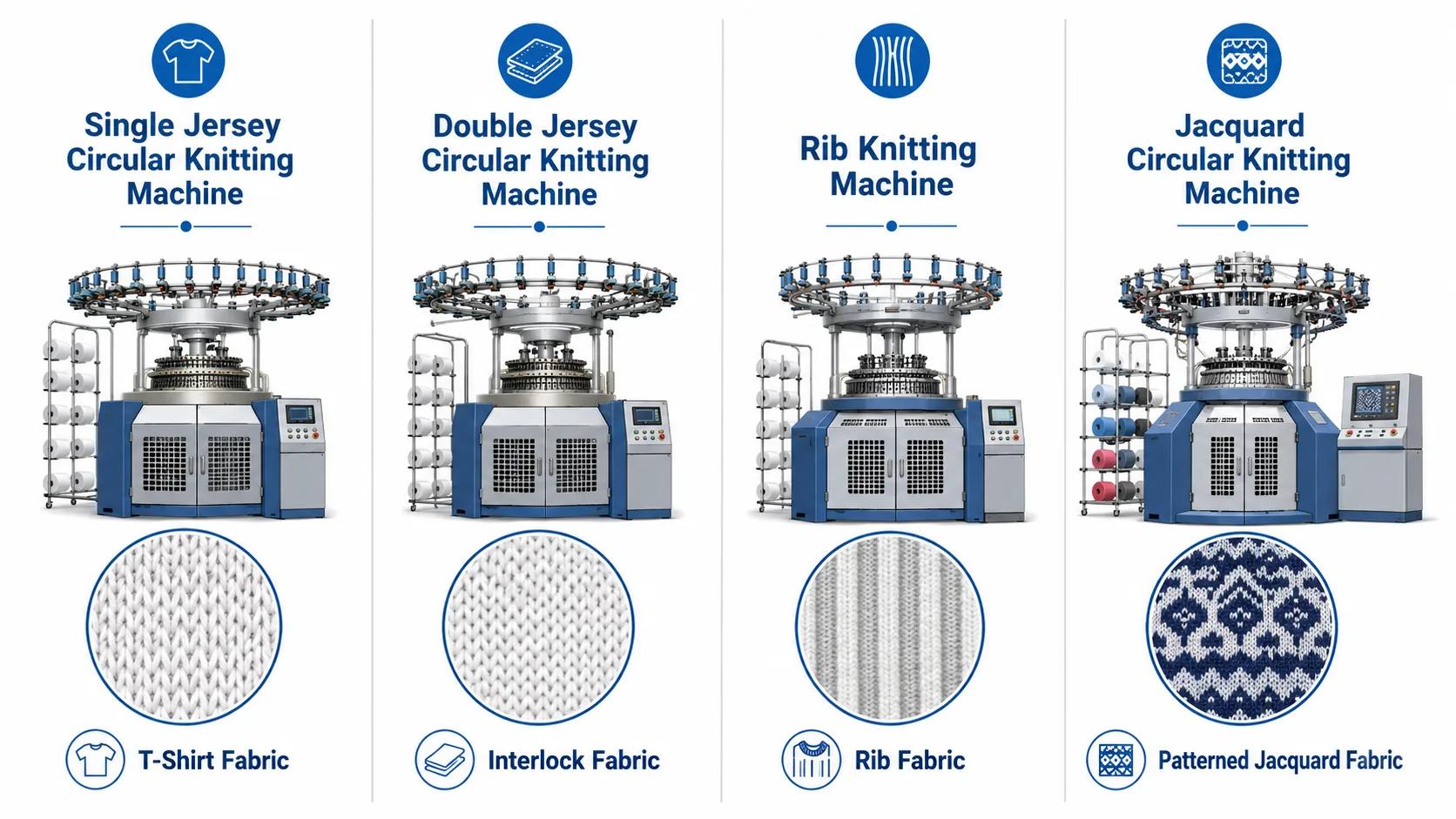
Under common industrial conditions, a 30 inch single jersey machine produces roughly 300 to 450 kg per day, a 34 inch machine with more feeders passes 500 kg per day, and an interlock machine delivers around 180 to 240 kg per day, with exact figures depending on gauge, feeders, RPM, stitch length, yarn, and efficiency. Benchmarks are useful as sanity checks on a calculation, never as substitutes for one.
Published industry figures for standard constructions cluster in the following ranges:
Machine Type | Diameter | Feeders | Typical RPM | Approx. Output per Day |
Single jersey | 30 inches | 90 | 30 RPM | 280 to 450 kg of 140 to 160 GSM fabric |
Single jersey | 34 inches | 102 | 26 RPM | 320 to 500 kg of standard fabric |
Interlock | 30 inches | 72 | 24 RPM | 180 to 240 kg |
Rib | 30 inches | 60 to 72 | 18 to 28 RPM | Proportionally lower per feeder |
Comparing candidate machines on these figures is where buyers discover that feeders and sustained efficiency move the daily total more than a headline RPM number, which is why a high speed knitting machine is only faster in practice if it holds its speed without extra stops. Two machines with identical nominal speed can differ by double digit percentages in daily output once real yarn and operating conditions enter the picture.
Actual output falls below the theoretical figure because the formula assumes continuous knitting, while a real knitting floor loses 8 to 15 percent of its time to yarn breaks, package changes, doffing, cleaning, inspection, and style changes, which is captured by applying an efficiency factor. In a well managed mill, single jersey efficiency typically ranges from 85 to 92 percent, and every point of efficiency is worth roughly one percent of daily output on identical machines.
The main sources of lost time, with their typical shares, look like this:
Loss Source | Typical Share of Time |
Yarn breakage stops | 2 to 4 percent |
Cone and package changes | 1 to 2 percent |
Quality inspection stops | 1 to 2 percent |
Cleaning and maintenance | 1 to 3 percent |
Needle replacement and repairs | 1 to 2 percent |
Style or yarn lot changes | 0 to 2 percent |
A factory should use its own historical efficiency data whenever possible instead of relying on an optimistic percentage copied from a specification sheet. Three practical rules keep the number honest. First, define exactly which losses the efficiency factor includes, and deduct any additional losses, such as start up fabric or rejected sections, only once. Second, a high set RPM does not guarantee high daily production: frequent yarn breaks and unstable tension can make a slower but more stable setting more productive across 24 hours. Third, record actual efficiency per machine and per style, because the average hides the outliers that wreck a delivery schedule. Gross knitted weight is also not the same as saleable weight, so usable output should be netted for start up pieces and inspection cuts before it feeds into costing.
The basic formula assumes every needle knits at every feeder, so structures with tuck, miss, transfer, or plating actions must be calculated yarn system by yarn system, using the effective number of knitting actions in one complete pattern repeat instead of the full needle and feeder count. Plain single jersey is the straightforward case; everything else needs a correction.
The main adjustments follow the structure:
Rib and interlock: two needle beds are involved, so consumption is calculated for both the dial and the cylinder, effectively roughly doubling loop consumption per revolution compared with a single bed of the same gauge.
Jacquard and mesh structures: miss and tuck feeds do not consume a full loop from every needle, so count the effective knitting actions per pattern repeat. A jacquard circular knitting machine may knit at every feeder but consume less yarn per feeder than the plain formula assumes, and the repeat must be worked out construction by construction.
Fleece and terry: the effect or pile yarn adds substantial consumption on top of the ground yarn, so each of the three thread systems in a three thread fleece construction is calculated separately and the weights summed.
Elastane plated fabrics: the ground yarn and elastane have very different linear densities and feeding ratios, so calculate their consumption separately and add the two weights; elastane adds little mass but measurably affects speed and efficiency.
As a rule, build the estimate from the pattern repeat itself rather than adjusting the plain result with an arbitrary percentage, because the pattern geometry, not a rule of thumb, determines the real loop count.
Verification compares the calculated estimate against weighed greige production and recalculates the true efficiency, turning a one off estimate into planning data that improves with every running style. A calculation that is never checked stays a guess; a calculation that is checked becomes an asset.
The workflow that most competent planning departments converge on is:
Record machine diameter, gauge, total needles, available feeders, pattern, yarn systems, and target speed for each running style.
Determine the active needles and effective feeds for one complete pattern repeat, and never count a miss feed as full consumption.
Convert every yarn to tex and every stitch or repeat length to metres, keeping ground, plating, and effect yarns separate.
Calculate theoretical kilograms for each yarn system, add the systems, then multiply by scheduled minutes and apply the planned efficiency for that same scheduled period.
Compare the result with weighed greige rolls, calculate the actual efficiency achieved, and update the planning data for that exact machine and style.
One caution applies throughout: never promise a delivery from the theoretical number alone. The theoretical figure is the ceiling, the weighed output is the truth, and the gap between them is your real efficiency, which only floor data can supply.

To plan an order in reverse, divide the order weight by the expected actual production per hour for that exact style and machine. For a 5,000 kg order on a machine delivering 21.4 kg per hour, the requirement is roughly 234 running hours, which should then be divided by the realistic utilization of the machine across the week to convert into calendar days. Working from scheduled hours rather than calendar hours keeps the promise date honest, because every style change and maintenance window must be subtracted from the calendar before the running hours fit.
A calculation is only as good as its inputs, so it should be refreshed at every trigger point rather than on a fixed calendar. Recalculate whenever the yarn count, stitch length, machine speed, or fabric structure changes, and recheck the efficiency factor at least monthly against weighed greige output. Mills that review efficiency after every style change build a planning database that gets sharper each season, while those using a single annual average keep absorbing the same surprises in every schedule.
No, because price reflects build quality, automation level, and pattern capability as much as raw output. A costlier machine earns its premium through sustained speed, fewer stops, and lower maintenance, so the correct comparison is expected kilograms per day at realistic efficiency against total cost of ownership, not the price tag alone. Two machines at similar prices can differ by double digit percentages in daily output, and an over specified machine running simple fabrics may never recover its cost.