
- All
- Product Name
- Product Keyword
- Product Model
- Product Summary
- Product Description
- Multi Field Search
Views: 5 Author: Site Editor Publish Time: 2026-09-16 Origin: Site


Knitted fabrics account for a large share of global apparel production, and the industrial circular knitting machine is the workhorse behind that output. From T-shirt jersey and sportswear mesh to towels, fleece, and medical textiles, almost every high-volume knit product starts on a circular knitting line. For a fabric manufacturer, purchasing one of these machines is a major capital investment that will shape fabric quality, daily output, and profitability for the next decade, so the selection process deserves the same rigor as any strategic business decision.
To choose the right industrial circular knitting machine for your business, start by defining the fabric type and end products you will manufacture, then match machine gauge and cylinder diameter to those products, confirm that speed, feeder count, and yarn compatibility meet your daily output targets, and finish by comparing total cost of ownership, build quality, and after-sales support rather than purchase price alone.
The sections below walk through each of these decision factors step by step so you can build a clear, defensible specification before you request quotations.
An industrial circular knitting machine is a production-scale textile machine that converts yarn into continuous tubular fabric using hundreds of needles arranged around a rotating cylinder, making it the standard equipment for mass-producing knitted textiles.
In operation, yarn is drawn from a creel and delivered through feeders that maintain precise tension. As the cylinder rotates, cam tracks raise and lower each needle so that fresh yarn is drawn through the previous loop, forming interlocking stitches in an endless spiral. Because the fabric is produced as a seamless tube, downstream cutting and sewing costs drop, and stitch formation stays uniform across long production runs. A detailed overview of how knitting machines form fabric is maintained on Wikipedia for readers who want the underlying mechanics.
These machines range from small-diameter units for narrow goods such as socks to large-diameter models producing wide fabric for home textiles. Choosing the wrong configuration leads to high defect rates, missed delivery deadlines, and a stretched payback period, while the right machine anchors a profitable knitting operation for years.

The single most important selection step is mapping your target fabric to the correct machine type, because the needle bed configuration determines which structures the machine can knit at all.
A machine built for single jersey cannot produce stable interlock, and a terry machine is not an efficient choice for plain T-shirt cloth. Use the table below as the starting point of your specification:
Target Fabric | Machine Type | Typical Applications |
Single jersey, lightweight mesh, pique | Single jersey circular knitting machine | T-shirts, underwear, linings |
Rib, interlock, double-faced structures | Double jersey circular knitting machine | Cuffs, waistbands, sportswear, premium knits |
Terry loop, three-thread fleece | Terry and fleece circular knitting machine | Towels, bathrobes, sweatshirt fleece |
Jacquard and multicolor patterns | Electronic jacquard circular knitting machine | Fashion fabrics, branded patterns, upholstery |
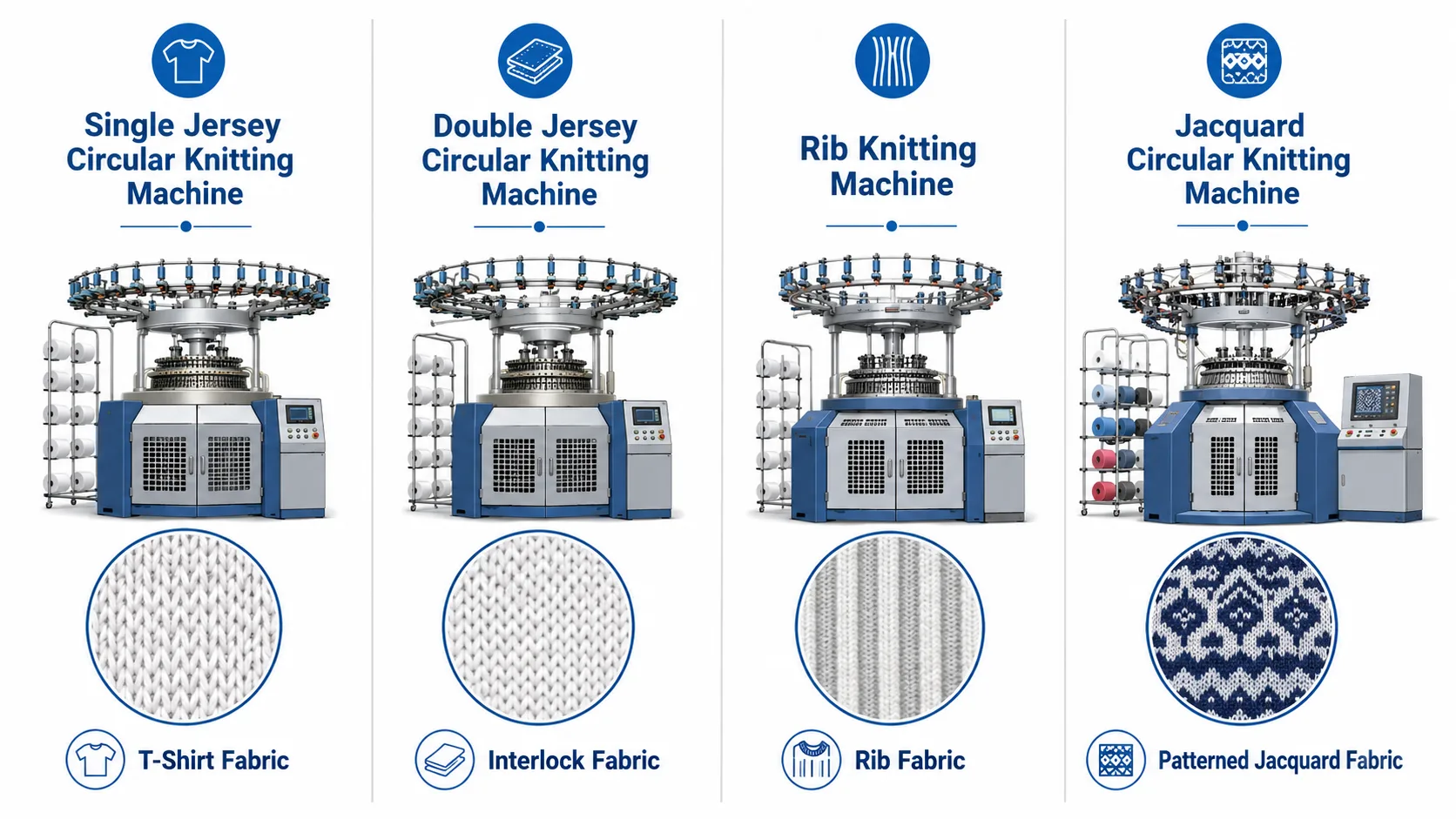
Single jersey fabrics are generally lightweight, around 120 to 200 grams per square meter, with one smooth face and a tendency to curl at the edges. Double jersey fabrics, knitted with both a cylinder and a dial, are heavier, more stable, and resist edge curling, which makes them suitable for structured garments and technical applications. If your business plans to serve several fabric categories, plan for multiple machine types from the start rather than forcing one machine to cover every structure.
After machine type, gauge and cylinder diameter are the two fixed specifications that most directly determine what your fabric will look and feel like, so both must be chosen against your dominant product line.
Gauge refers to the number of needles per inch on the cylinder. More needles per inch means smaller loops, finer fabric, and smoother surfaces, while fewer needles per inch produces thicker, heavier fabric.
Gauge Range | Fabric Characteristics | Typical Products |
Coarse, E12 and below | Thick, heavy, insulating | Winter knitwear, blankets, technical textiles |
Medium, E14 to E20 | Balanced weight and durability | Hoodies, sweatshirts, casual apparel |
Fine, E24 to E32 and above | Light, smooth, high stitch density | T-shirts, underwear, base layers, seamless wear |
For cotton T-shirt production, gauges in the E24 to E28 range are the most common choice because they balance fineness with production speed. Keep in mind that gauge is fixed at manufacture: a machine cannot be converted from coarse to fine later, so a mill producing both fleece and fine underwear will need separate machines at different gauges.
Cylinder diameter determines the circumference, and therefore the width, of the fabric tube. Diameters commonly range from around 12 to 40 inches for apparel production, with 30-inch and 34-inch machines dominating general garment fabric because their tube width suits standard cutting layouts. Larger diameters serve wide home textiles such as bedding, while small diameters are reserved for narrow products like socks, gloves, and sleeves.
Match the diameter to your finished fabric width plus a shrinkage allowance, since knitted fabric narrows during finishing. A diameter that is too small forces inefficient cutting layouts, while an oversized machine consumes floor space and increases cost without adding usable width.
Capacity planning comes down to three linked parameters, namely rotational speed, feeder count, and machine efficiency, and they must be matched to your real daily output requirement rather than to brochure maximums.
Rotational speed, measured in revolutions per minute, typically reaches 25 to 35 RPM on single jersey machines, while double jersey machines run slower, around 20 to 30 RPM, and jacquard machines slower still, because complex needle selection and coordinated cylinder-and-dial movement take more time per course. Feeder count matters just as much: each feeder knits one course per revolution, so a 30-inch single jersey machine with 90 feeders produces far more fabric per revolution than one with 45 feeders, even at identical speed.
Under continuous two-shift or three-shift operation, a standard large-diameter single jersey machine can produce several hundred kilograms of fabric per day, while double jersey output typically runs 20 to 30 percent lower. Note that running at maximum rated speed increases vibration, yarn breakage, and defect risk, so many mills deliberately operate slightly below the maximum to protect quality.
Production Scale | Recommended Configuration |
Small workshop or startup | Standard speed and feeder count, simple controls, low entry cost |
Medium factory with stable orders | High feeder count, servo drive, electronic tension control |
Large-scale or rush-order production | High-speed models, full automation, production monitoring systems |
Before committing to a machine, confirm that its needle specification, feeders, and tension system can handle the exact yarns your products require, from cotton and polyester to spandex blends and recycled fibers.
Different fibers behave very differently on the machine. Cotton and viscose run on most standard configurations, while spandex and other elastomeric yarns demand dedicated feeders and extremely stable tension, because even small tension fluctuations create stretch defects and width variation. Recycled and slub yarns, increasingly common in sustainability-driven collections, are more prone to breakage and benefit from sensitive yarn break detection.
Feeding hardware also determines what you can knit. Positive feeders and electronic storage feeders deliver a constant yarn length per revolution, which keeps stitch length consistent and stabilizes fabric weight across the roll. Basic machines carry a small number of feeders suited to plain fabrics, while multicolor jacquard production requires far more feeding positions, often with separate ground and pattern yarn paths. If you expect to diversify into patterned fabrics, choose a machine whose creel and feeder system can be expanded later.

The right level of automation is the level that reduces defects and operator workload for your team, not the longest feature list on the market.
Modern industrial circular knitting machines offer a wide range of control and automation options, and each one addresses a specific operational pain point:
Touchscreen human-machine interfaces for fast parameter changes and pattern selection
Pattern memory storage, which recalls repeat designs without reprogramming
Real-time yarn break detection that stops the machine before defects accumulate
Automatic lubrication systems that meter needle oil and prevent dry running
Fabric roll monitoring and shift counters for production tracking
Remote diagnostics and Industry 4.0 connectivity for centralized mill management
For a large factory running dozens of machines across shifts, remote monitoring and data integration pay for themselves quickly by cutting unplanned stops. A small workshop with skilled operators may find a simple, robust control system easier to learn and cheaper to maintain. Match the control complexity to your workforce, because an advanced interface that nobody can use becomes a source of downtime rather than a cure for it.
Long-term reliability depends more on component quality and support infrastructure than on any single specification, so evaluate the machine as a ten-year service relationship rather than a one-time purchase.
Key components to scrutinize include the needle cylinder, cams, needles, sinkers, and bearings, since their machining precision directly governs stitch consistency and service life. Frames should be rigid enough to damp vibration at high speed, and wearing parts should be accessible for routine inspection without major disassembly.
Maintenance demands also differ between machine types. Double jersey machines, with their cylinder-and-dial arrangement, generally require more maintenance hours per year than single jersey machines, and dust build-up around the feeder ring must be managed on any machine to prevent yarn breaks. Look for automatic lubrication, clear maintenance documentation, and generous access panels that shorten cleaning and inspection time.
On the support side, a reputable supplier should provide on-site installation and operator training, a warranty of at least one year, guaranteed spare parts availability with short lead times, and responsive remote or hotline troubleshooting. Ask specifically how quickly engineers can reach your facility, because every day of unplanned downtime in peak season directly erodes margins.
The smartest way to compare machines is by total cost of ownership, which combines purchase price with energy, maintenance, spare parts, training, and expected defect losses over the machine's working life.
A low purchase price can become expensive if the machine breaks down frequently, consumes more energy per kilogram of fabric, or produces defect rates that waste yarn and dyeing capacity. Conversely, a more capable machine often pays back faster through higher output, lower labor pressure, and better fabric quality. Industry bodies such as the International Textile Manufacturers Federation track textile machinery investment trends, and their reporting consistently shows mills shifting spending toward efficiency and automation rather than capacity alone.
When building your financial model, include:
Purchase price, delivery, installation, and commissioning
Energy consumption per kilogram of fabric produced
Annual maintenance and spare parts budgets
Operator training costs and labor requirements
Expected defect rate and the value of wasted yarn
Realistic utilization, typically 80 to 90 percent of planned hours
As a rule of thumb, well-matched machines in mid-range configurations commonly reach payback within roughly two years under a stable order book, while poorly matched purchases can stretch well beyond that. Energy-efficient motor systems, variable frequency drives, and low-friction transmissions reduce operating cost per kilogram and increasingly matter for buyers with sustainability requirements.
A short, disciplined checklist prevents the most expensive purchasing errors, which almost always come from matching the machine to the brochure instead of to the business.
Before you sign a purchase contract, confirm:
The fabric types and structures the machine must produce, now and in the next two to three years
Daily output targets in kilograms or meters, across realistic shift patterns
Gauge and diameter matched to your dominant products and cutting layouts
Compatibility with your actual yarn palette, including any spandex or recycled content
Workshop conditions: floor space, ceiling height, power supply, and climate control
Spare parts pricing and availability, plus warranty and training terms in writing
Financials modeled on total cost of ownership, not quotation price alone
The most common mistakes are predictable. Buyers chase maximum speed and discover that stitch quality suffers on their actual yarn. They choose the cheapest quotation and pay the difference back in downtime and defects. They overlook workshop constraints until installation day. And they assume after-sales support will be adequate without ever testing the supplier's response time. Each of these errors costs more than the small amount of planning time needed to avoid it.
Prices vary widely with machine type, diameter, gauge, feeder count, and automation level. Basic single jersey configurations start in the low tens of thousands of US dollars, while fully equipped computerized jacquard machines can reach several times that figure. Compare offers on total cost of ownership rather than the quotation alone.
Most cotton T-shirt fabrics are knitted on machines in the E24 to E28 range, which balances fineness, hand feel, and productivity. Gauges above E30 suit premium lightweight and seamless products but run more slowly and demand higher, more consistent yarn quality.
With preventive maintenance and regular replacement of wearing parts such as needles and cams, a well-built machine commonly remains in productive service for 10 to 15 years, and heavy-duty frames can be reconditioned and kept running even longer.