
- All
- Product Name
- Product Keyword
- Product Model
- Product Summary
- Product Description
- Multi Field Search

Views: 2 Author: Site Editor Publish Time: 2026-10-13 Origin: Site


A knitting mill can change yarn count, adjust stitch length, add an elastane attachment, or swap cams, but it cannot easily change gauge. Gauge is built into the cylinder, the dial, the needle tricks, and the cam box, so the number chosen at the ordering stage quietly decides which yarns the machine can run, how heavy the fabric can become, how fast the machine can turn, and which markets the finished roll can serve. Buying teams that pick a gauge by price, or by the largest number on a specification sheet, often discover months later that the machine cannot knit the yarn already sitting in the warehouse or the fabric weight their customers keep reordering.
Choosing the right circular knitting machine gauge means matching needle density to three variables at once: the target fabric structure and weight, the yarn count you intend to run, and the end use the fabric has to serve. Heavy fabrics above roughly 250 gsm call for a coarse gauge, standard T-shirt and polo weights of about 140 to 190 gsm sit in the medium range, and lightweight innerwear, fine jersey, and performance fabrics need a fine gauge. The right number is the one that reproduces your target fabric reliably, at a practical running speed, using yarns your mill can actually source.
This guide explains what gauge is, how it maps to fabric weight and yarn count, how to match it to a specific fabric, and how to verify the decision before capital is committed.
Gauge is the density of needles around the cylinder of a circular knitting machine, expressed as the number of needles per inch of cylinder circumference and written with the letter E. A higher E number means more, finer needles packed into every inch, which produces smaller loops and finer fabric, while a lower E number means fewer, heavier needles and larger loops.
Because every needle occupies one groove in the cylinder, gauge fixes two things at once: how fine a yarn the machine can control, and how small a loop it can form. On a circular knitting machine with a 30-inch cylinder at E24, roughly 2,260 needles are working around the dial, while the same cylinder at E18 carries about 1,696. That difference in needle count is what separates a machine that knits 180 gsm single jersey from one that knits 300 gsm fleece. The underlying idea is shared with hand knitting, where gauge describes the number of stitches per inch, but on a circular machine the value is a fixed mechanical property rather than an adjustable setting.
Gauge, needle pitch, and total needle count are related but not identical, and confusing them leads to specification errors.
Term | What It Describes | Example |
Gauge (E) | Nominal needles per inch of cylinder circumference | E24 |
Needle pitch | Center-to-center distance between adjacent needles | Roughly 1.06 mm at E24 |
Needle count | Total active needles around the cylinder | A 30-inch cylinder at E24 gives about 2,260 needles |
Needle count, not gauge alone, sets output per revolution and the maximum fabric width, because a larger diameter at the same gauge simply adds more needles. Gauge sets the fineness; diameter sets the scale.
Two labelling systems appear on machine datasheets, and they are not interchangeable.
English gauge (E) counts needles in one inch and is the standard notation for weft knitting machines, including circular machines.
GG counts needles in 1.5 inches and is traditionally applied to flat-bed full-fashioned machines and some older circular machines.
A value written as 24 GG is therefore not the same as E24. When comparing machines from different suppliers, always confirm which system the number uses, and confirm the machine type as well, because knitting machine terminology and classification are standardised precisely to prevent this kind of mismatch. As a practical rule, circular machines are almost always quoted in E, while sweater gauges such as 3G, 5G, 7G, and 12G usually refer to flat machines.
Gauge influences loop size, and loop size drives fabric density, thickness, GSM, drape, opacity, and surface texture. As gauge rises, loops shrink, fabric becomes denser and lighter per square metre, and the surface reads smoother; as gauge falls, loops enlarge, fabric becomes thicker and heavier, and the texture becomes more pronounced.
The direction of the effect is predictable even though the exact number depends on yarn and stitch length.
Decision | Lower Gauge Tendency | Higher Gauge Tendency |
Needle spacing | Wider spacing | Closer spacing |
Yarn range | Coarser, bulkier yarns | Finer yarns |
Loop size | Larger loops | Smaller loops |
Fabric surface | Visible texture, heavier hand | Smooth, refined surface |
Typical weight | Heavier GSM | Lighter GSM |
Running speed | Lower RPM, higher torque | Lower RPM, tighter tolerances |
Gauge and yarn count must be matched, because the needle hook and the gap between needles physically limit the yarn that can pass through. If the yarn is too thick for the gauge, the hook cannot clear the loop cleanly, and the result is dropped stitches, slubs, high yarn tension, and accelerated needle wear. If the yarn is too fine, the needles cannot control the loop uniformly, and the fabric becomes sleazy, transparent, and unstable.
Textile engineers express this relationship with an empirical constant. For cotton single jersey, optimum count is often estimated as the count in Ne equals the gauge squared divided by a constant of roughly 18 to 20. By that logic, an E24 machine suits cotton yarns near Ne 28, while an E18 machine suits coarser counts. The relationship is a starting point for trials, not a substitute for them, because fibre type, twist, and stitch length shift the practical window.
Gauge sets the loop scale, but it does not by itself set finished GSM, softness, or strength. Two machines at the same gauge can produce different fabric weights if stitch length, feeder configuration, yarn count, take-down tension, or finishing differ. Gauge is a strong constraint on the achievable range, not a guarantee of a specific result. This is why fabric specifications should always be confirmed through a knitted and finished sample rather than assumed from the gauge number.

The most reliable way to choose a gauge is to start from the target fabric and work backwards to needle density. The chart below maps common gauge ranges to yarn counts, fabric weights, and typical end uses, using the English gauge system.
Gauge Range | Yarn Count (Ne) | Typical Fabric Weight | Typical Fabrics and End Use |
E5 to E12 | Ne 4 to 12 | 250 to 400 gsm | Heavy knitwear, terry, fleece, technical textiles |
E13 to E18 | Ne 12 to 24 | 180 to 300 gsm | Sweatshirt fabric, rib, heavy jersey, industrial textiles |
E18 to E22 | Ne 20 to 32 | 140 to 200 gsm | Standard T-shirt and polo, basic activewear |
E22 to E26 | Ne 28 to 40 | 110 to 160 gsm | Fine jersey, interlock, premium T-shirts, underwear |
E28 to E40 | Ne 40 to 60 | 60 to 120 gsm | Seamless garments, fine innerwear, hosiery, performance fabric |
Fine gauge covers roughly E28 to E40. These machines run very fine yarns and produce light, smooth, high-density fabric for seamless garments, fine innerwear, luxury T-shirts, and performance sportswear. Fine gauge demands more from the whole production chain: consistent yarn quality, precise cylinder and dial manufacturing, accurate cam adjustment, and disciplined maintenance. A fine gauge machine fed an unsuitable yarn will drop stitches and wear needles quickly, so the fabric target must justify the tighter tolerances.
Medium gauge covers roughly E18 to E26 and represents the commercial mainstream of circular knitting. This is the range that produces the bulk of single jersey, rib, and interlock fabric used in T-shirts, polo shirts, underwear, and general sportswear. A single jersey knitting machine in this range balances fabric weight, running speed, and yarn cost, which is why it is the default starting point for mills entering cut-and-sew apparel production.
Coarse gauge covers roughly E5 to E16 and produces heavy, stable fabrics. This is the range for sweatshirt and fleece fabric, heavy rib, outerwear, and home textiles. A three-thread fleece machine, for example, uses a coarse gauge and a dedicated sinker system to build the looped back that becomes brushed fleece. Coarse gauge machines run at lower RPM but move more yarn per stitch, so their output in kilograms can remain competitive even though the fabric weight is far higher.
Five factors should drive the decision: fabric structure, yarn count, machine diameter and feeders, end use and price point, and the maintenance reality of running that gauge day after day. Gauge should be the outcome of these factors, not the starting point.
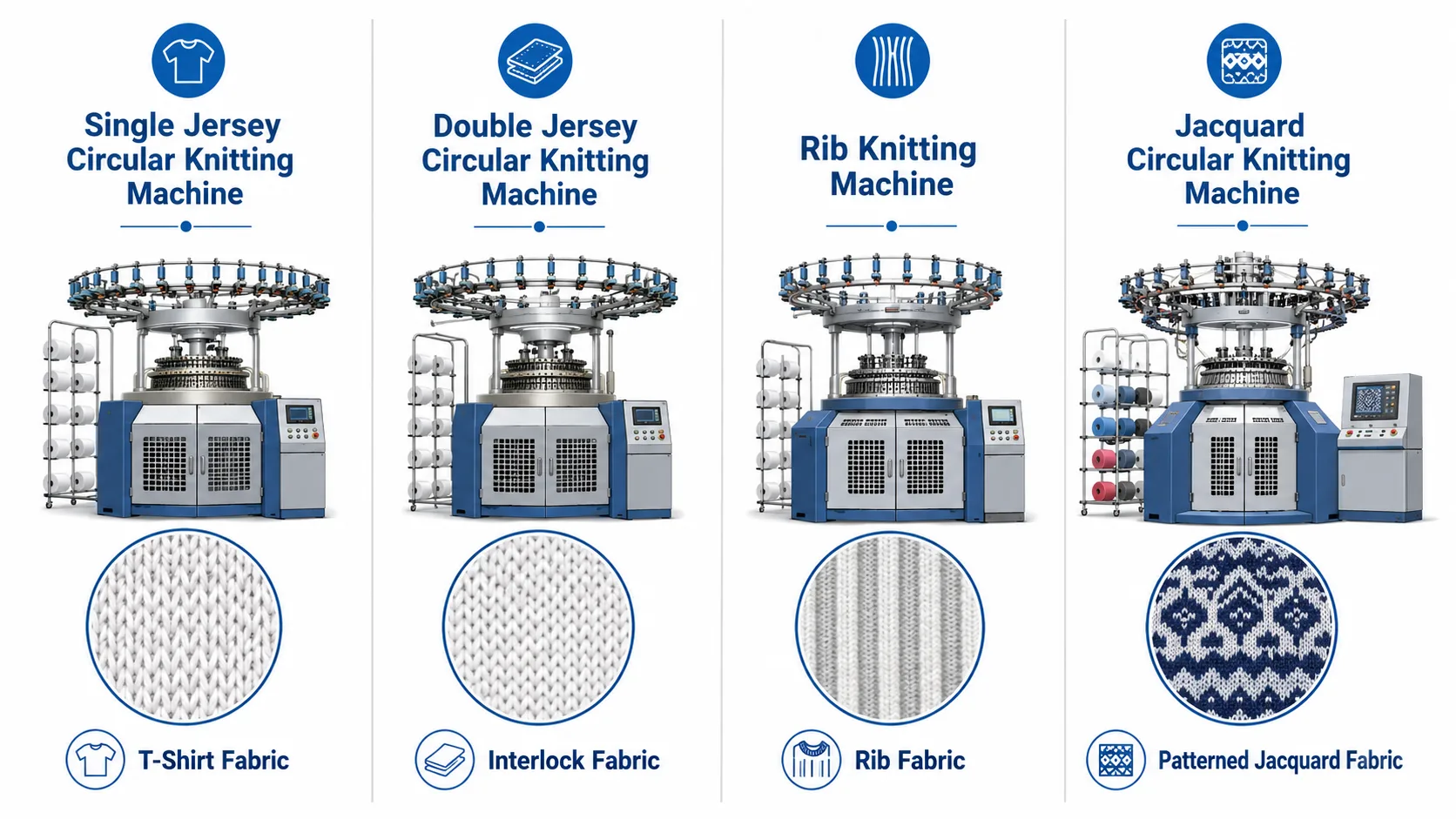
Different structures place different demands on needle density. Plain single jersey, pique, mesh, rib, interlock, fleece, and jacquard each have a practical gauge window. A double rib knitting machine, which uses needles in both cylinder and dial, behaves differently from a single jersey machine and cannot simply be pushed to the same fineness. Confirm the structure first, then let it define the gauge band.
Gauge and yarn count are locked together. Fine gauge needs finer, more consistent, and usually more expensive yarn, while coarse gauge tolerates bulkier and often cheaper yarn. Fibre type matters too: staple cotton, filament polyester, and elastane blends all behave differently at the same count, and elastane feeding changes the effective stitch density. Match gauge to the yarns your supply chain can deliver reliably, not to the ideal yarn in a catalogue.
Gauge does not operate alone. Diameter sets fabric width and needle count, and the number of feeders sets courses per revolution. Higher gauge generally means lower RPM because finer needles tolerate less mechanical stress, so a fine gauge machine may knit more slowly even as it produces lighter fabric. Calculate output in kilograms per hour from diameter, gauge, feeders, RPM, yarn count, and realistic efficiency rather than from a brochure figure.
The same fabric weight can serve very different markets. Fine gauge fabric commands a premium in premium apparel and seamless categories but costs more to produce and requires better yarn. Coarse gauge fabric is cheaper per kilogram at the yarn level but competes in price-sensitive markets. Choose the gauge that matches the market your fabric is actually sold into, not the most technically impressive number available.
Higher gauge means more needles, finer clearances, and greater sensitivity to lint, tension, and alignment. Fine gauge machines need more frequent cleaning, lubrication, and needle inspection. Coarse gauge machines are more forgiving but still wear under high yarn tension. Plan for needle, sinker, and cam replacement from the beginning, and confirm that consumables are available with reasonable lead times before committing to a gauge.

To determine the gauge of a machine, count the needles in one inch of cylinder circumference, or divide the total needle count by the cylinder circumference in inches. To determine the correct gauge for a fabric, run a controlled sample trial and measure the finished result rather than predicting it from a table.
Gauge is normally engraved on the machine plate and repeated in the manual, but it can be verified directly. Total needle count divided by cylinder diameter in inches gives the working gauge. Industry association documentation on knitting machinery notes that the English gauge is conventionally measured from one side of a needle to the same side of another needle within one inch, which is the method to follow if any doubt remains. Always confirm that the stated gauge reflects the current needle set, since a machine may have been re-needled or have needles deliberately omitted.
The only reliable verification is a knitted and finished sample. Provide the supplier with a fabric sample or clear image, the fibre composition, yarn count and type, target GSM, finished width, tubular or open-width requirement, and the intended end use. Then run the trial through to dyeing and finishing and measure GSM, width, courses and wales per inch, shrinkage, and hand feel. Gauge is correct only when the finished fabric meets the specification repeatedly, not when a single greige swatch looks acceptable.
A 5 gauge machine has five needles per inch, while a 7 gauge machine has seven, so the 7 gauge is finer: it forms smaller loops, uses finer yarn, and produces a lighter, smoother fabric, while the 5 gauge produces a thicker, heavier fabric with larger loops. These values usually describe flat sweater machines rather than circular machines.
Comparison | 5 Gauge | 7 Gauge |
Needles per inch | 5 | 7 |
Yarn count | Coarser, roughly Ne 4 to 8 | Finer, roughly Ne 8 to 14 |
Fabric weight | Heavier, chunky knitwear | Medium, standard sweaters |
Typical products | Chunky sweaters, heavy outerwear | Medium sweaters, cardigans, jersey knits |
Needle and cam stress | Lower, more forgiving | Higher, tighter tolerances |
The same logic extends across the whole scale. Moving from 5 gauge to 7 gauge is one step finer; moving from E18 to E24 on a circular machine is a much larger step in the same direction, because circular gauges run from about E5 up to E40, while flat sweater gauges rarely exceed 18.
Most gauge mistakes come from choosing the number before defining the fabric, then trying to fix the problem with yarn or settings that the gauge cannot support.
Choosing the highest available gauge on the assumption that finer always means better, then discovering that the machine runs slowly and consumes expensive yarn.
Selecting gauge by price or by maximum RPM instead of by the target fabric and market.
Treating a brochure table as a specification and skipping the sample trial.
Matching gauge to yarn count by eye rather than by a documented relationship and a controlled trial.
Assuming gauge alone determines GSM, and ignoring stitch length, feeders, and finishing.
Overlooking spare parts availability and maintenance load when moving to a finer gauge.
Forgetting that one machine can produce several fabrics by changing cams, needles, and yarn feeding, so the gauge should cover the whole product range rather than a single item.

Can the gauge of a circular knitting machine be changed after purchase? In practice, no. Changing gauge requires replacing the cylinder, dial, cams, and often the sinkers, which costs a large fraction of a new machine and is rarely economic. This is why gauge should be treated as a permanent decision made before the order.
Does a higher gauge always mean higher fabric quality? No. Higher gauge produces finer loops, but quality depends on matching yarn, stitch length, tension, and maintenance to the target fabric. A well-run medium gauge machine can produce better fabric than a poorly matched fine gauge machine.
Which gauge suits seamless underwear and performance activewear? Seamless garments and fine performance fabrics typically use fine gauge machines in the E28 to E34 range, often with elastane feeding. A seamless underwear knitting machine in this band produces the light, smooth, high-stretch fabric these products require.