
- All
- Product Name
- Product Keyword
- Product Model
- Product Summary
- Product Description
- Multi Field Search

Views: 1 Author: Site Editor Publish Time: 2026-11-23 Origin: Site


Knitting factories run on tight delivery windows, and a flat knitting machine carries several thousand needles across two beds. Most stoppages do not come from dramatic breakdowns. They come from a bent latch, a dry cam track or a trick slot packed with fibre that nobody checked at shift change.
A flat knitting machine maintenance checklist works as a frequency ladder, not a single list: cleaning and inspection every shift, lubrication and stitch-length checks every week, deep mechanical and electrical checks every month, accuracy recalibration every quarter, and a full overhaul once a year. Every line needs a method, a time allowance and a written pass or fail standard, so the result does not depend on who is standing at the machine.
The needle bed and carriage set the defect rate directly. A V-bed carriage travels at roughly 0.8 to 1.5 metres per second and each needle flexes up to 200 times per course, so one worn latch or a cam face running dry produces a dropped stitch within three to five courses and a run across the full panel width.
The economics are asymmetric. A fault caught at the machine costs minutes and one needle; caught at panel inspection it costs the panel and its yarn; caught after washing it costs the garment and the buyer conversation.
Daily work covers only what touches yarn and what must move freely, and should take five to ten minutes per machine at the start of a shift: lint removal from the bed and trick slots, a latch and hook scan across a sample of needles, a check of the yarn path, and confirmation that guards, emergency stops and light curtains respond.
Task | Method | Time | Acceptance standard |
Needle bed surface | Soft brush and air at or below 0.4 MPa, along the slots | 3 min | No fly or oil sludge in the slots |
Needle latch and hook | Visual pass, 20 to 30 needles per bed | 2 min | No bent hook, no latch failing to close |
Sinker and cam race | Brush only, no air into bearing housings | 1 min | Sinkers seat flush, no fibre at cam entry |
Yarn path and feeder | Wipe guides, inspect ceramic eyelets | 1 min | No wrap, no cut groove catching filaments |
Take-down roller | Inspect for wrap and residue | 1 min | Surface clean, fabric pulls evenly |
Control alarms | Read the shift log | 1 min | No alarm carried over unexplained |
Compressed air is the most misused tool in a knitting hall. Above 0.5 MPa it drives fibre past the needle butts into bearing housings, where it mixes with oil and grinds instead of clearing.
The deposit to remove is sludge, not dry fly. A bed that looks wet can still run dry at the butt and cam interface, and a slot that feels gritty under a nylon scraper is already scoring the needle butt: the mechanical origin of most dropped stitches, long before the fabric shows a hole.
Ceramic eyelets wear in a groove that stays invisible until a filament catches in it, so run a fingernail across the contact face rather than looking at it. Feeder height should let yarn enter the hook just below the top edge; set too high, the needle drags the yarn down and the selvedge knits tight.
A light curtain that has drifted out of alignment still allows production, which is why the misalignment survives for weeks. Hold the hall at 15 to 28 degrees Celsius and 40 to 60 percent relative humidity, since dry air lifts fly onto the bed and damp air rusts selectors.
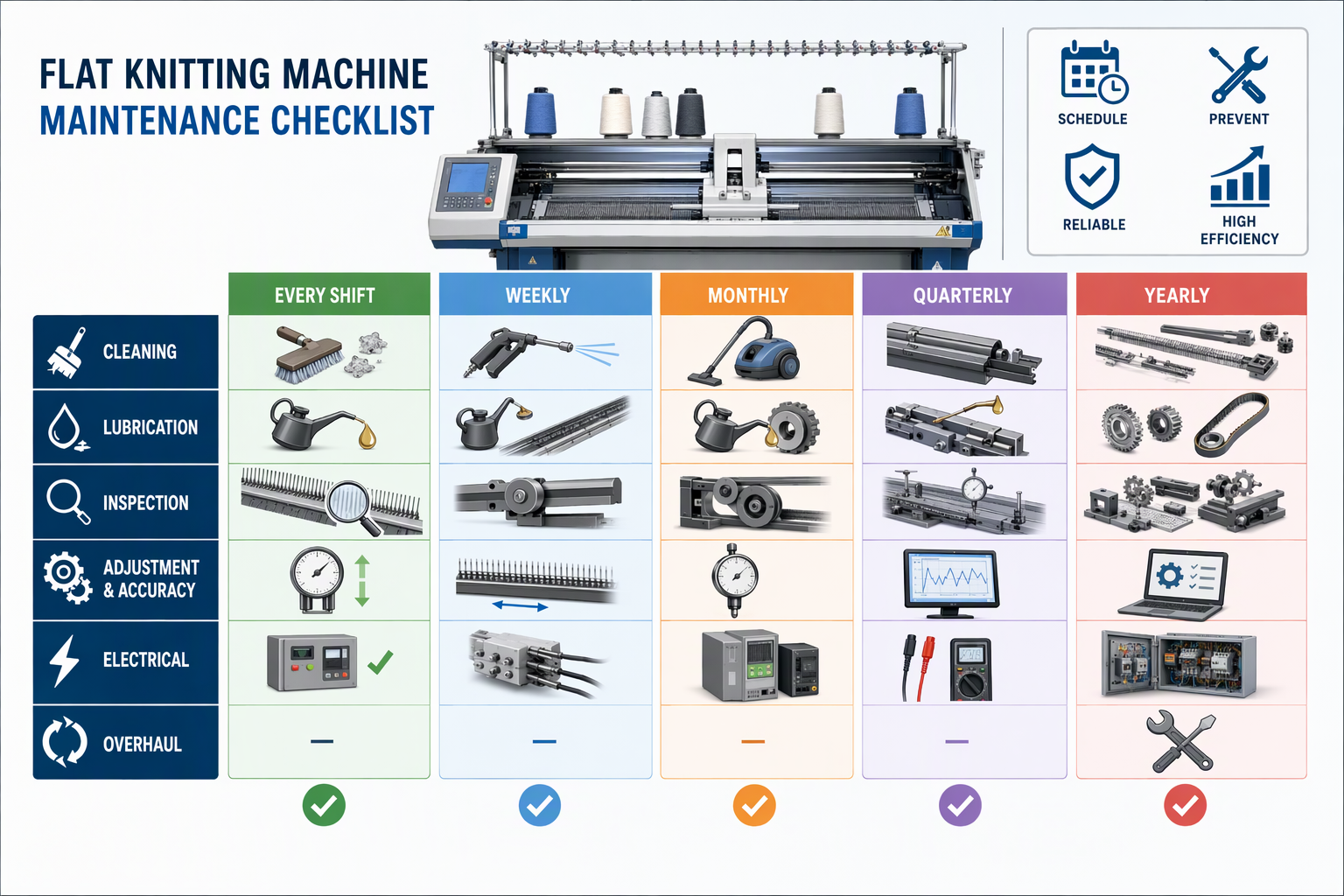
Weekly work moves from the surface into the moving parts: every sliding and rolling surface receives the specified lubricant, and the machine is measured against a stitch-length standard instead of being judged by feel. Allow 30 to 45 minutes per machine, scheduled when it is warm but not producing.
Lubrication point | Lubricant | Interval | Note |
Needle bed, jacks, select jacks, selectors | ISO VG 22 or VG 32 knitting oil | Every 8 to 12 service hours | Thin film only |
Cam tracks and needle butts | Same oil, at the cam entry | Every 8 to 12 service hours | Oil, never grease |
Carrier rail and carriage rails | ISO VG 32 | Every 8 to 12 service hours | Wipe the old film first |
Carriage guide sliders | ISO VG 32 | Every 8 to 12 service hours | Check lateral play |
Inside carriage and cam box | Grease to specification | Monthly | Small quantity |
Reservoir and oil filter | Replace and clean | 2 to 4 months continuous, 4 to 6 intermittent | 1 to 2 months above 35 degrees |
The 8 to 12 hour figure is a running-hour interval, not a calendar one. Three-shift plants routinely misapply it by lubricating once a week, when the machine has actually run 120 hours.
Viscosity follows ambient conditions and load. VG 22 flows into the fine clearances around selectors and suits cooler halls and fine gauges, while VG 32 holds a film under the contact pressures of coarse gauge and heavy yarn. Mixing the two changes film thickness at the highest-load point.
The point that matters most is the least visible. The needle butt running against the cam track carries the heaviest unit load on the machine and sits under the carriage, where oil applied to the visible bed may never reach it. Apply at the cam entry, then run a short idle cycle.
Knit a 50-course test panel from the same yarn lot each week and compare course length with the calibration chart. Drift beyond plus or minus 2 percent points to bed wear, a glazed take-down roller or a slipping drive belt.
Monthly work addresses systems that degrade invisibly: belt tension, cooling airflow, gearbox grease, oil line condition and roller pressure. Quarterly work addresses geometry and electrical integrity, which cannot be judged by eye and require instruments.
Frequency | Task | Method | Acceptance |
Monthly | Carriage drive belt tension | Deflection gauge at both stroke ends | Within spec, uniform |
Monthly | Controller and motor filters | Remove, blow out, refit | Free airflow, no matted fibre |
Monthly | Central lubrication lines | Drain, flush, refill | Clean oil, no metal particles |
Monthly | Take-down roller pressure | Gauge across the width | Even selvedge to selvedge |
Monthly | Course and wale count per 10 cm | Against the tolerance table | Inside tolerance |
Quarterly | Motor insulation resistance | Megohmmeter | At or above 2 megohms |
Quarterly | Bed straightness and level | Straightedge and dial gauge | Within maker's tolerance |
Quarterly | Cam and sinker cam profile | Wear measurement at the working face | Below the wear limit |
Annually | Carriage teardown, bearing renewal | Planned stop with technician support | Back to commissioning figures |
Pull two to three percent of needles per bed each quarter, sampled across the full width, and record the position of every reject. Positions cluster: one end of the bed points to level or belt tension, the middle to a cam or take-down fault, and scattered rejects to yarn abrasion or contaminated oil.
Needle life commonly falls between 6 and 24 months, and the spread is explained by the yarn rather than the machine, so replacement knitting needles are best stocked by gauge rather than by model. Sinkers last two to three times as long but wear at the throat, where a burr reads as barre rather than as a hole.
A flat knitting machine needs attention on five clocks: cleaning every shift, lubrication and stitch verification every week, deep checks every month, accuracy recalibration every quarter, and a full overhaul annually. These are starting points that must be shortened for multi-shift running, coarse gauge, abrasive fibres, high humidity and machines held near maximum speed.
Factor | Effect on wear | Adjustment |
Three-shift operation | Running hours accumulate three times faster | Keep hourly intervals, halve calendar ones |
Abrasive or glass-fibre yarn | Needle and sinker wear accelerates | Monthly needle audit, replace early |
Coarse gauge, heavy count | Higher butt and cam loads | Shorten lubrication to 6 to 8 hours |
Ambient above 35 degrees | Oil oxidises faster | Halve the oil change interval |
Humidity above 65 percent | Rust risk on beds and selectors | Daily check, dehumidify |
Two-shift and three-shift plants need the same running-hour routine at different frequencies, so write intervals in service hours and let the planner convert them. Where in-house capability stops at cleaning and lubrication, a scheduled service support visit covers the quarterly accuracy work and the annual teardown.

Seven components account for most unplanned flat knitting stops: needles, sinkers, cams and cam plates, carriage drive belts, bearings, selector solenoids and position sensors. Each has a recognisable signature on the fabric, which lets a defect be traced to a part rather than to the whole machine.
Component | Typical life | Failure signs | Fabric symptom |
Needle | 6 to 24 months | Bent hook, weak latch, burred butt | Vertical run, hole, isolated drop |
Sinker | 12 to 36 months | Worn throat, burr on forming edge | Uneven loop, barre, tight wale |
Cam or cam plate | 3 to 6 years | Grooved track, chipped edge | Horizontal banding, tight course |
Carriage drive belt | 2 to 5 years | Fraying, glazing, uneven tension | Stitch drift across the width |
Bearing | 3 to 8 years | Noise, heat, vibration | Repeating mark at fixed intervals |
Selector solenoid | 4 to 8 years | Slow response, missed selection | Isolated pattern error |
Sensor or encoder | 3 to 7 years | Intermittent signal, drift | Random stops, pattern offset |
Reading a defect backwards is a skill worth building into the shift team. A mark repeating at the same interval is mechanical; a mark at a fixed position across the width is a needle or trick slot; a band spanning the full width is a cam, a belt or a density setting. Naming faults consistently makes that reasoning possible, and the terminology for knitted structures is standardised in ISO 8388. That discipline is also what turns a defect report into an order for the right flat knitting machine spare parts instead of a full set.
The split follows one rule: anything needing a tool, energy isolation or partial disassembly belongs to the technician, and everything else belongs to the operator. Operators clean, inspect and lubricate; technicians adjust, calibrate, replace and diagnose.
Operator responsibility | Technician responsibility |
Clear fly, fibre and sludge from beds and feeders | Any task needing guards removed or power isolated |
Inspect needles, sinkers, belts and guides | Bearing, gearbox, cam and drive train work |
Apply the specified lubricant at marked points | Setting, timing and calibration |
Report noise, heat and vibration beyond the standard | Vibration and oil analysis, standard approval |
Fifteen items per machine per shift is close to the practical ceiling, and eight to ten is better. A list of forty gets ticked without being read, and a ticked list that hides a fault is worse than none because it creates false confidence. Mount the card at the machine and put a photograph beside each line.
Three classes cover almost everything: an operator tag for a fault the shift team can fix, a maintenance tag for work needing tools or isolation, and a safety tag for a missing guard or exposed conductor. The system fails at closure rather than at reporting, since tags left open for two weeks teach operators that reporting has no effect.
Completion rate alone proves nothing, because a card can be ticked without the work being done. Four measures taken together show whether maintenance is real: overall equipment effectiveness, mean time between failures, needle consumption per thousand panels, and the time taken to close an abnormal-finding tag.
Metric | Source | What it reveals | Direction |
OEE | Availability x performance x quality | Where loss sits | Up |
MTBF | Running hours divided by failures | Reliability trend | Up |
MTTR | Repair hours divided by repairs | Maintainability, spares readiness | Down |
Needle use per 1,000 panels | Needles issued divided by output | Bed condition, yarn abrasion | Down |
Tag closure time | Hours from raised to closed | Whether reporting is credible | Down |
Stitch-length drift | Test panel against standard | Bed and take-down condition | Within 2 percent |
Keep one log per machine rather than one per department. A machine log records what that machine has needed over two years, which is the only basis for deciding whether to overhaul, re-gauge or replace it, and those records also serve as documented evidence of infrastructure control under ISO 9001.

Idle time is measured in conditions rather than days. Beyond about four weeks in a humid hall, unprotected beds and selectors begin to corrode, so apply a rust preventive film, cover the machine and run a short idle cycle weekly. Relubricate before restarting, because oil drains from the cam faces during storage.
The mechanical routine is the same, with tighter tolerances and shorter intervals. The additions are electrical and thermal: clean controller and motor filters monthly, keep the cabinet sealed, protect the supply against voltage fluctuation, and back up pattern files and parameters after any change. Oil-bound fibre on an optical sensor also produces intermittent stops that are easily misread as software faults.
Machine identification and gauge, date and shift, the task performed, a pass or fail result against the written standard, parts replaced with their bed position, oil grade and quantity, measured values such as stitch length and belt deflection, and the tag numbers raised and closed. The single entry matters less than the trend across a year.