
- All
- Product Name
- Product Keyword
- Product Model
- Product Summary
- Product Description
- Multi Field Search
Views: 488 Author: Site Editor Publish Time: 2026-04-07 Origin: Site


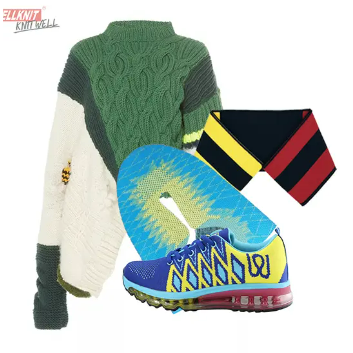
A flat knitting machine is used to produce flat knitted panels for sweaters, scarves, collars, shoe uppers, and other shaped knit products. Unlike circular knitting machines, which make tubular fabrics, flat knitting machines offer better control over garment shaping, patterns, and small-batch customization.
A flat knitting machine is a type of knitting equipment designed to produce flat pieces of knitted fabric, as opposed to tubular or circular shapes. Unlike circular knitting machines that create seamless tubes of fabric, flat knitting machines produce knitted fabric in flat panels, which are often later sewn together to form garments such as sweaters, scarves, and accessories.
The machine operates by using a series of needles aligned in a straight line or a flat bed to interlock loops of yarn. These loops form the knitted fabric, which can vary widely in pattern, texture, and density based on the knitting technique and machine programming.
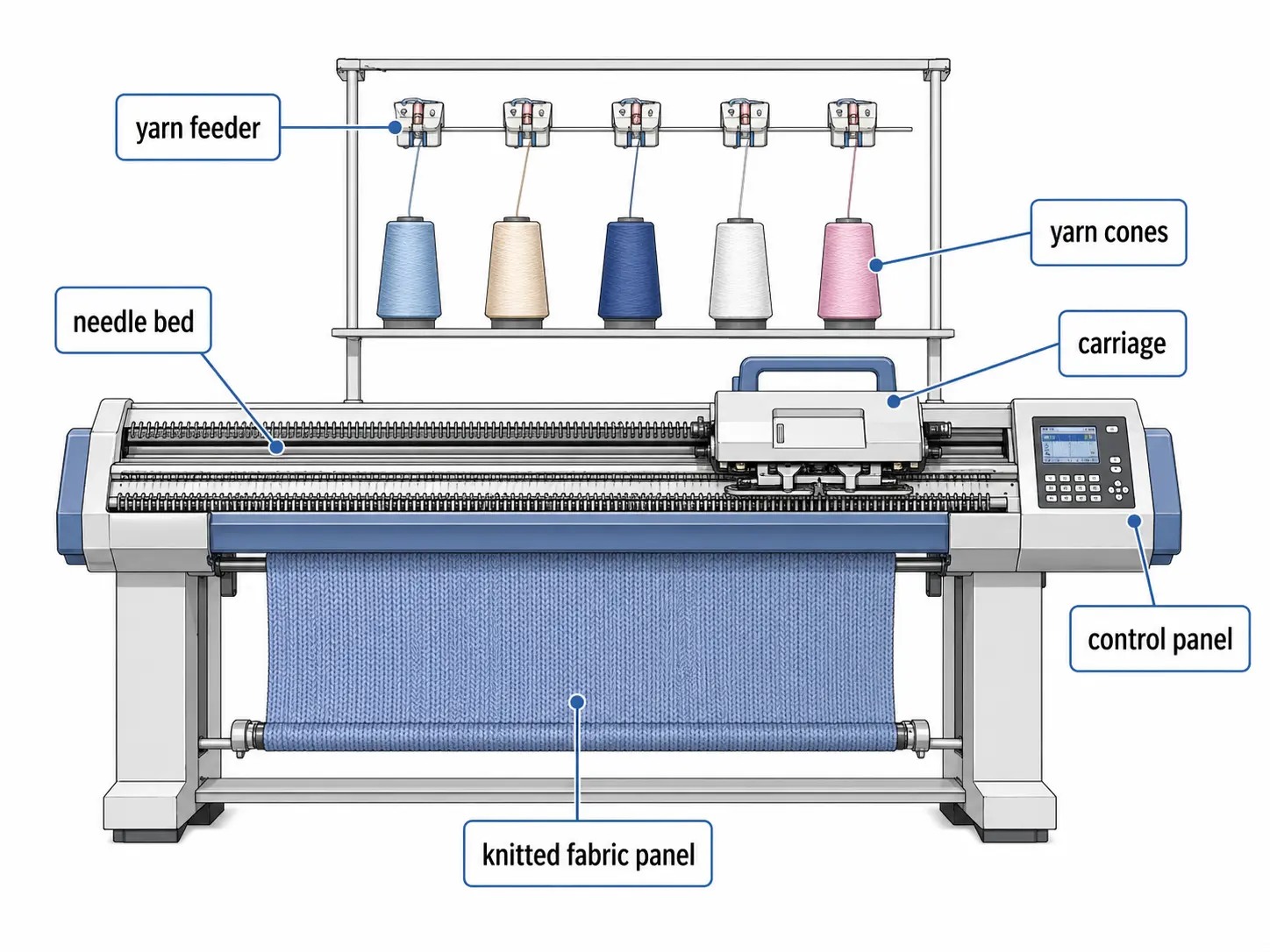
The basic structure of a flat knitting machine includes:
Needle bed: A flat surface containing rows of latch needles or similar types of knitting needles.
Yarn feeders: Devices that supply yarn to the needles during knitting.
Carriage: The moving part that travels back and forth across the needle bed to create stitches by manipulating the needles.
Control system: Modern flat knitting machines are equipped with electronic or computerized controls that allow pattern programming and precise control over stitch formation.
| Comparison Item | Flat Knitting Machine | Circular Knitting Machine |
|---|---|---|
| Fabric Shape | Produces flat fabric panels | Produces tubular fabric |
| Main Products | Sweaters, scarves, collars, cuffs, shoe uppers | T-shirts, socks, hosiery, seamless tubes |
| Design Flexibility | Better for shaping, patterns, and customized panels | Better for continuous simple fabric production |
| Production Speed | Usually slower for simple fabrics but more flexible | Usually faster for tubular fabrics |
| Garment Shaping | Can create shaped garment pieces | Limited shaping ability |
| Best For | Knitwear, fashion panels, small-batch customization | High-volume production of simple tubular fabrics |
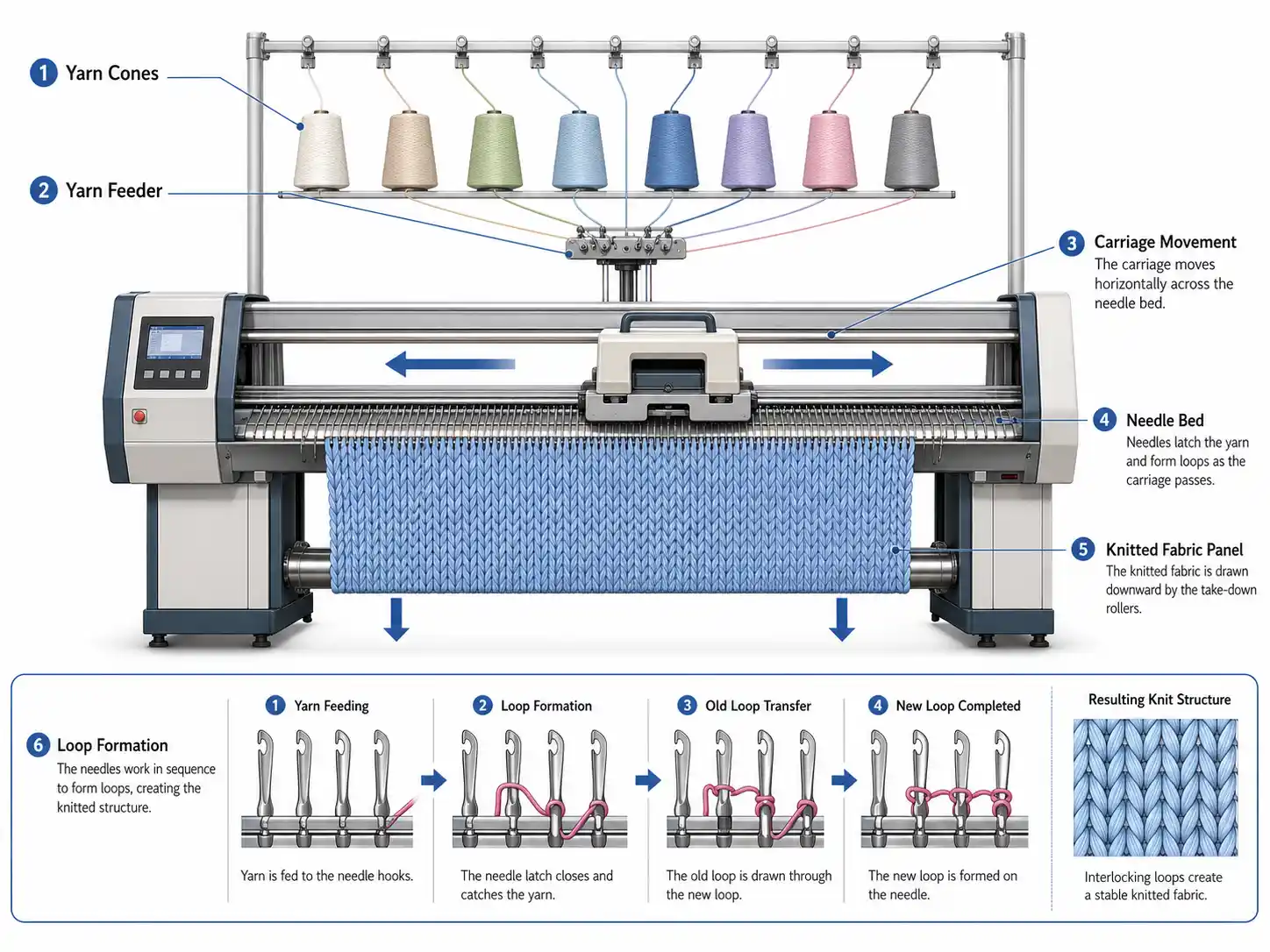
The knitting process in a flat knitting machine involves creating a series of interlocking loops, row by row, using the needles mounted on the flat needle bed. Here is a simplified explanation of how the machine works:
Yarn Feeding: Yarn is fed continuously from yarn cones through tensioners and feeders to the needles.
Needle Action: The carriage moves across the needle bed. As it travels, it manipulates the needles by lifting and lowering them to catch the yarn.
Loop Formation: The needles pull the yarn through previously formed loops to create new loops, which interlock to form the knitted fabric.
Fabric Take-down: As the carriage moves back and forth, the fabric is slowly pulled downward or forward, making space for new rows.
Modern flat knitting machines utilize advanced electronics to precisely control needle selection, stitch length, and pattern design. This enables complex shapes and knit structures to be programmed and knitted automatically.
There are several types of flat knitting machines, distinguished primarily by their needle types and intended applications:
Latch Needle Machines: Use latch-type needles and are the most common type, ideal for standard knitwear production.
Bearded Needle Machines: Use needles with a flexible “beard” to form loops; these are older models, less common today.
Rib Machines: Equipped with two needle beds facing each other to create ribbed fabrics.
Fully Fashioned Flat Knitting Machines: These are capable of shaping garments during knitting, reducing the need for cutting and sewing.
Each type is optimized for specific fabric structures and garment types, giving manufacturers options based on their product needs.
To better understand flat knitting machines, it is important to become familiar with the technical parameters that define their capabilities:
Gauge means the number of needles per inch. It affects how thick or fine the fabric will be. Lower gauges are suitable for thick yarns and heavier products, such as chunky sweaters and winter scarves. Higher gauges are suitable for fine yarns and lighter garments.
Needle count means the total number of needles on the machine. It affects the maximum width of the knitted fabric. If you need to produce wider panels, larger sweaters, scarves, or blankets, you may need a machine with more needles.
Stitch length means the amount of yarn used in each stitch. It affects how tight, soft, or elastic the fabric feels. Shorter stitch length makes the fabric tighter and denser. Longer stitch length makes the fabric softer and more flexible.
Knitting speed shows how fast the machine can produce fabric. A higher speed can improve production efficiency, but the actual speed depends on the yarn, pattern, gauge, and machine model. For complex patterns, stable knitting is more important than high speed.
The carriage moves back and forth across the needle bed to help form stitches. Smooth carriage movement can make the fabric more even and reduce defects. It is also important for making patterns and shaped garment pieces.
The control system is used to set patterns, stitch size, needle selection, and other knitting functions. A computerized control system makes it easier to create different designs, adjust settings, and produce customized products.
| Parameter | What It Means | Why It Matters When Choosing a Machine |
|---|---|---|
| Gauge | Number of needles per inch | Determines fabric thickness and fineness. Lower gauge is for thick yarns, while higher gauge is for fine yarns. |
| Needle Count | Total number of needles on the machine | Affects the maximum fabric width and product size. |
| Stitch Length | Amount of yarn used in each stitch | Affects fabric tightness, softness, elasticity, and hand feel. |
| Knitting Speed | How fast the machine produces fabric | Affects production efficiency, but stable performance is more important for complex patterns. |
| Carriage Movement | Movement of the carriage across the needle bed | Affects stitch quality, pattern accuracy, and production stability. |
| Control System | System used to manage patterns and machine settings | Makes it easier to create designs, adjust settings, and produce customized products. |
Choosing the right flat knitting machine depends on your product type, fabric requirements, production capacity, and long-term service needs. For beginners or manufacturers planning to upgrade their knitting equipment, the following factors are especially important:
Gauge refers to the number of needles per inch on the needle bed. A lower gauge is suitable for thicker yarns and heavier fabrics, such as chunky sweaters and winter knitwear. A higher gauge is better for finer yarns and lightweight garments. Selecting the proper gauge helps ensure the desired fabric texture, density, and appearance.
The needle bed width determines the maximum width of the knitted panel. For products such as sweaters, scarves, collars, or shoe uppers, manufacturers should choose a machine width that matches their product dimensions. A suitable needle bed width can improve production efficiency and reduce unnecessary material waste.
Different products require different knitting functions. If you need complex color patterns, jacquard capability is important. If your designs include large color blocks or graphic patterns, intarsia knitting may be required. For garment panels with shaped edges, armholes, or necklines, a fully fashioned or shaping function can help reduce cutting and sewing work.
Not all machines are suitable for every yarn type. Before choosing a flat knitting machine, it is important to consider whether it can process cotton, wool, acrylic, polyester, blended yarns, or specialty yarns. Good yarn compatibility allows manufacturers to develop a wider range of products and respond more flexibly to market demand.
A flat knitting machine is a long-term investment, so after-sales support is just as important as machine performance. Reliable technical service, available spare parts, operator training, and maintenance guidance can help reduce downtime and keep production running smoothly.
Flat knitting machines bring numerous benefits that make them an essential tool in textile manufacturing:
Flat knitting machines, especially modern automated models, can produce complex knit fabrics quickly and consistently. Their automation reduces manual intervention, speeding up production without sacrificing quality.
One of the most significant advantages is the ability to create intricate patterns, textures, and shapes directly on the machine. Unlike cut-and-sew methods, flat knitting machines can shape garment pieces during knitting, minimizing waste and enabling seamless design integration.
Modern flat knitting machines are equipped with computerized control systems that allow easy programming of patterns and stitch modifications. This facilitates rapid design changes, prototyping, and small-batch production, meeting market demand for customization and fast fashion.
Flat knitting machines can handle a wide range of yarn types and fabric structures, from lightweight lace to dense ribbed fabrics. They are suitable for various end products, including sweaters, scarves, hats, shoe uppers, and technical textiles.
The precise needle control and automated tension regulation ensure consistent stitch formation, reducing defects and improving garment quality.

Flat knitting machines are compatible with a broad spectrum of yarn materials, which influences the final fabric's texture, strength, and application:
Cotton:
Soft, breathable, and comfortable, cotton yarns are commonly used in flat knitting to create everyday apparel like t-shirts, sweaters, and baby clothes.
Wool and Wool Blends:
Wool provides warmth and elasticity, ideal for knit sweaters, scarves, and hats. Blended wool yarns combine natural fibers with synthetics for enhanced durability and texture.
Synthetic Fibers:
Polyester, nylon, and acrylic yarns offer strength, elasticity, and moisture-wicking properties, making them popular in sportswear and performance garments.
Blended Yarns:
Combining natural and synthetic fibers allows manufacturers to tailor fabric characteristics, balancing comfort, durability, and ease of care.
Technical and Specialty Yarns:
For advanced applications, flat knitting machines can handle yarns infused with antibacterial agents, reflective fibers, or conductive threads for smart textiles.
Single Jersey:
The simplest knitted fabric with smooth face and textured back, commonly used in casual apparel.
Rib Knit:
Featuring vertical ribs, rib knit fabric is stretchy and commonly used in cuffs, collars, and form-fitting garments.
Jacquard and Patterned Knits:
Complex color and stitch patterns for decorative and functional designs.
Intarsia and Shaped Knits:
Incorporating color blocks and shaped garment pieces for seamless construction.
Flat knitting machines have become essential tools in today’s textile manufacturing industry, prized for their ability to produce high-quality, precisely shaped knit fabrics with detailed patterns and textures. For garment manufacturers seeking efficiency, design flexibility, and superior fabric quality, these machines offer unmatched advantages. Understanding their fundamentals—from construction and working principles to technical specifications and material compatibility—can empower businesses to elevate their knitwear production.
As technology continues to advance, flat knitting machines are evolving with smarter controls and greater adaptability, enabling innovation across a wide range of textile products—from classic sweaters to stylish accessories and cutting-edge technical fabrics.