
- All
- Product Name
- Product Keyword
- Product Model
- Product Summary
- Product Description
- Multi Field Search
Views: 158 Author: Site Editor Publish Time: 2025-09-22 Origin: Site


A Circular Knitting Machine is a vital piece of equipment in the modern textile industry. As the name suggests, it operates in a circular motion to knit fabrics in tubular form. These machines have revolutionized fabric production by enabling high-speed, continuous, and efficient manufacturing of various knitted materials. From T-shirts to high-performance sportswear, the Circular Knitting Machine plays a central role in everyday clothing production and industrial applications.
A Circular Knitting Machine is a textile machine that forms fabric by creating interlocking loops of yarn using a series of needles arranged in a circular needle bed. The process is based on controlled mechanical movement driven by cam systems, enabling continuous fabric formation with high production efficiency.
Unlike weaving, which interlaces yarns at fixed angles, circular knitting produces fabric through loop formation, where each newly formed loop is drawn through the previous one in a continuous sequence.
The fundamental structure of knitted fabric is the loop. In a circular knitting system, yarn is supplied through multiple yarn feeders positioned around the machine. Each feeder delivers yarn into the knitting zone in sequence, allowing multiple loops to be formed simultaneously across different needles.
Inside the needle cylinder, each needle is guided by a cam system that controls its precise up-and-down movement. During each cycle, the needle opens its latch, receives yarn, and draws it through an existing loop to form a new stitch.
This coordinated loop formation process allows the machine to produce fabric in a continuous manner, making it highly suitable for large-scale textile manufacturing. The quality and consistency of the fabric depend on machine precision, yarn properties, and feeding stability.
Needles are the core forming elements in a circular knitting machine. The most commonly used type in modern high-speed machines is the latch needle, which enables stable and efficient loop formation. In some specialized applications, compound needles are also used for higher precision and speed requirements.
Alongside the needles, sinkers play a supporting role in the knitting process. Their main function is to assist in loop formation by holding down the previously formed fabric and helping maintain proper fabric positioning during knitting. This ensures smooth loop transfer and stable fabric structure.
It is important to note that fabric tension is not controlled solely by sinkers. Instead, overall tension management is achieved through a combination of sinkers, yarn tensioners, and the take-down system.
A defining feature of a circular knitting machine is its rotary knitting operation. Depending on the machine design, either the needle cylinder rotates or the cam system rotates around a fixed cylinder, while the knitting action remains continuous.
As the machine operates, yarn feeders supply yarn continuously, and needles form loops in a synchronized circular sequence. This results in the production of tubular fabric directly from the machine.
The fabric output is typically in tube form, which can be used directly for products such as socks, seamless garments, and certain types of underwear, or slit open to produce flat fabric for further processing.
While circular knitting enables efficient production of tubular fabric, the final fabric characteristics—such as elasticity, density, and surface quality—depend on machine settings, yarn type, and fabric structure design rather than the circular mechanism alone.
The circular knitting process is a highly efficient, cam-controlled loop formation system that enables continuous fabric production. Its performance is determined by the interaction of needles, sinkers, yarn feeders, and take-down mechanisms, rather than a single mechanical component.
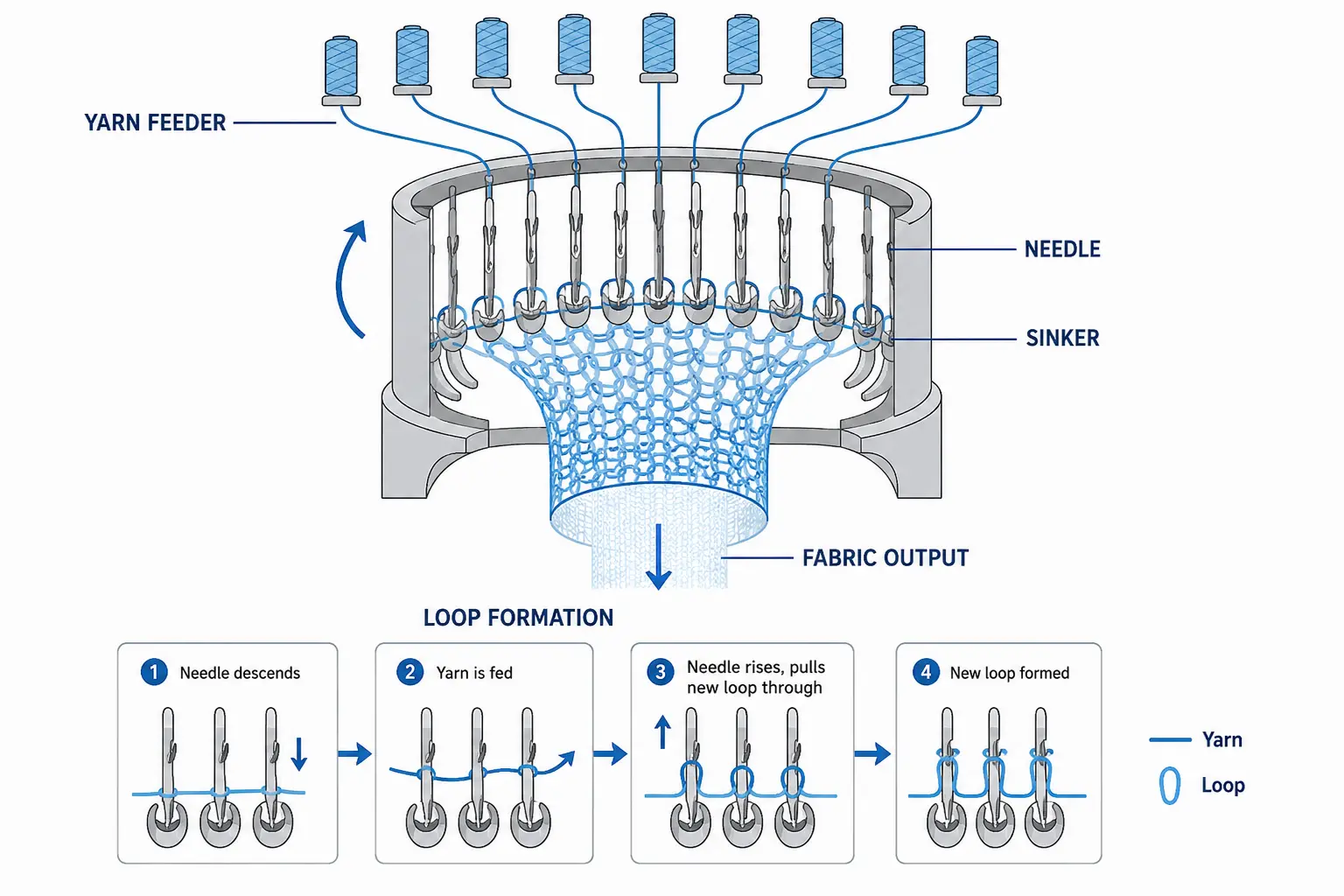
Understanding the internal structure of a circular knitting machine helps appreciate its efficiency and versatility.
The cylinder houses the vertical needles and is the main component rotating during the knitting process. For double-knit or rib fabrics, there is also a dial on top, where horizontal needles operate in conjunction with the cylinder needles to form complex stitch patterns.
Cams are metallic tracks that guide the needles in and out to create different loop heights and stitch types. Depending on the desired fabric, the machine might use:
Latch needles: The most common type, featuring a small latch that opens to catch the yarn and closes to form the loop.
Spring beard needles: Mostly used in older or fine-gauge machines, they rely on a spring mechanism to close the loop.
Compound needles: Used in advanced machines for high-speed operation and fine fabrics
Multiple yarn feeders evenly distribute yarn across the machine, ensuring uniform loop formation. The take-down system pulls the finished fabric downward and rolls it for storage. Consistent tension in this system is crucial for fabric quality.

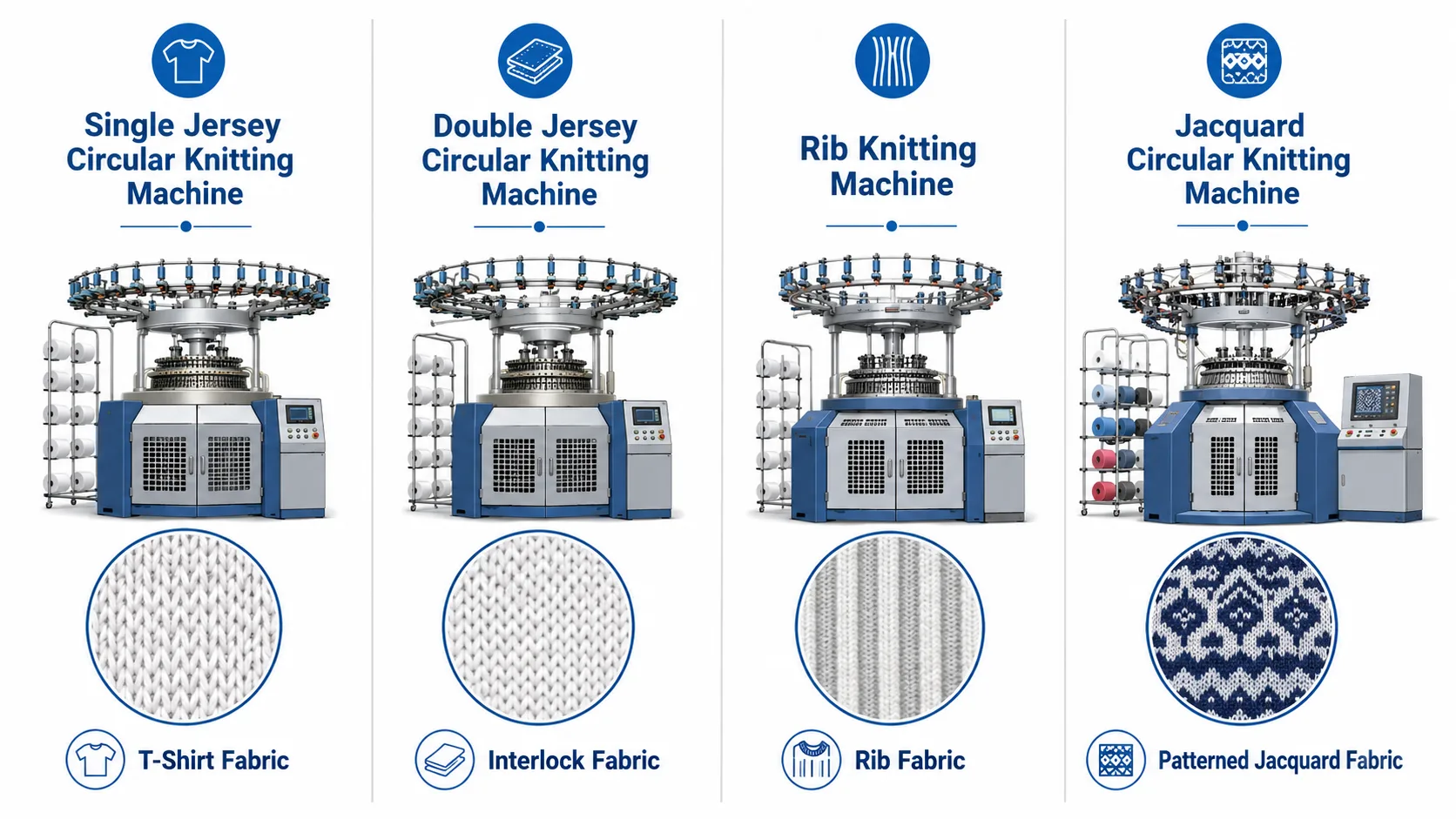
The diversity of circular knitting machines allows them to meet a wide range of production needs.
Single jersey knitting machines produce lightweight, stretchy fabrics with a smooth face and a textured back. Commonly used for T-shirts and casual wear.
Double jersey knitting machines have both cylinder and dial needles, creating thicker, more stable fabrics like interlock and rib.
Rib machines alternate knit and purl stitches to make stretchy, elastic fabrics used in collars and cuffs.
Interlock machines form two layers of fabric simultaneously, creating durable and soft textiles ideal for sportswear and baby clothes.
Jacquard circular knitting machines allow individual needle selection, enabling complex patterns, logos, and textured designs.
High-speed machines are optimized for mass production, with advanced yarn management systems, electronic controls, and minimal downtime.
The circular knitting machine is compatible with a broad spectrum of yarn types, making it highly versatile for different applications.
Cotton: Breathable and soft, ideal for everyday garments.
Polyester: Durable and moisture-wicking, commonly used in activewear.
Spandex (elastane): Adds stretch and recovery, important in sports and intimate apparel.
Blended yarns: Combining natural and synthetic fibers for enhanced performance and comfort.
Fine gauge machines (28G and above) are used for smooth, light fabrics like hosiery.
Coarse gauge machines (14G or lower) produce thicker fabrics for sweaters or industrial use.
The gauge (G) refers to the number of needles per inch of cylinder circumference, directly impacting the fabric's texture and application.
The output of a circular knitting machine is as diverse as its design.
T-shirts: Produced using single jersey machines for comfort and breathability.
Sportswear: Requires moisture-wicking and stretch, achievable through polyester-spandex blends on double jersey machines.
Underwear: Demands softness and flexibility, often made with fine gauge machines using cotton-spandex blends.
Seamless garments: Advanced circular machines can knit entire pieces without side seams, enhancing comfort and fit.
Circular knitting machines also cater to technical textiles:
Industrial fabrics: Used in filters, insulation, and composites.
Medical textiles: Compression bandages, orthopedic supports, and wound dressings.
These applications require specialized yarns and strict quality control, which modern circular knitting machines can deliver.

Circular knitting machines are widely used in the textile and garment industry. Their biggest advantage is that they can produce knitted fabric efficiently and continuously.
This is the most common application. Circular knitting machines are used to produce fabrics for:
T-shirts
Polo shirts
Underwear
Leggings
Dresses
Casual garments
The fabric is usually soft, stretchable, and comfortable, which makes it suitable for daily clothing.
Sportswear often requires stretch, breathability, moisture control, and comfort. Circular knitting machines can produce many knitted structures used in activewear, including mesh, jersey, interlock, and elastic fabrics.
Underwear fabric needs to be soft, smooth, and skin-friendly. Single jersey, rib, and interlock fabrics are commonly used in this area.
Some knitted home textile products can also be made with circular knitting machines, such as mattress fabric, decorative fabric, and certain soft furnishing materials.
Circular knitted fabrics may be used in elastic medical textiles, support garments, compression-related products, and hygiene-related textile materials. These applications usually require more precise control of fabric structure and material performance.
As textile production becomes more specialized, circular knitting machines are also used in some technical textile fields. These may include functional fabrics, automotive textiles, protective textiles, and industrial fabric materials.

Circular knitting machines are popular because they offer a strong balance between production efficiency and fabric flexibility.
Main advantages include:
High production speed
Continuous fabric output
Suitable for mass production
Good fabric elasticity
Wide fabric structure options
Stable fabric quality when properly adjusted
Compatibility with many yarn types
Ability to produce both basic and functional knitted fabrics
From a production point of view, the machine is especially valuable when a factory needs consistent output over long production runs. Once the settings are correct, the machine can produce large quantities of fabric with relatively stable quality.
However, it is worth noting that “high efficiency” does not mean the machine can solve every problem automatically. Yarn quality, operator skill, machine maintenance, and correct setup still matter a lot.
Some common problems include:
Dropped stitches
Missed stitches
Yarn breaks
Holes in the fabric
Uneven fabric tension
Needle marks
Oil stains
Fabric distortion
Irregular loop size
These issues can affect fabric appearance, strength, and production efficiency. For example, yarn breaks may stop production frequently, while uneven tension may create unstable fabric quality.
To keep the machine working properly, factories should pay attention to regular maintenance.
Useful practices include:
Check needles regularly and replace damaged ones.
Keep yarn tension stable during production.
Clean lint, dust, and yarn waste from the machine.
Use proper lubrication according to machine requirements.
Monitor fabric quality during production, not only after production.
Train operators to understand machine settings.
Check yarn quality before large-scale production.
Good maintenance does not only extend machine life. It also reduces fabric defects and production downtime.
Choosing a circular knitting machine should not start only from price. A lower-cost machine may not be economical if it cannot produce the required fabric or causes frequent quality issues.
The first question should be: What fabric do you want to produce?
For example:
T-shirt fabric may require a single jersey machine.
Rib cuffs may require a rib knitting machine.
Interlock fabric may require a double jersey machine.
Patterned fabric may require a jacquard machine.
Warm hoodie fabric may require fleece-related equipment.
Once the fabric type is clear, the machine configuration becomes easier to discuss.
Gauge and diameter are two important specifications.
Gauge refers to the number of needles per inch. In general, a higher gauge is used for finer fabrics, while a lower gauge is used for thicker fabrics.
Diameter affects the fabric tube size or fabric width. Larger-diameter machines are often used for wider fabric production.
Factor | What It Means | Why It Matters |
Gauge | Needle density | Affects fabric fineness and thickness |
Diameter | Size of the needle cylinder | Affects fabric width or tube size |
Feeders | Number of yarn feeding positions | Affects productivity and design flexibility |
Speed | Machine running speed | Affects production capacity |
Yarn Compatibility | Suitable yarn types and counts | Affects fabric performance and stability |
Different factories have different production goals. A small workshop may care more about flexibility, while a large textile factory may focus on output, stability, and automation.
Before purchasing, buyers should consider:
Daily or monthly production volume
Number of fabric types needed
Available factory space
Operator skill level
Power supply and installation conditions
Maintenance ability
Spare parts availability
Supplier support is easy to ignore, but it can be very important after purchase. Circular knitting machines require installation, adjustment, training, and long-term maintenance.
A reliable supplier should be able to provide:
Machine selection guidance
Technical specifications
Installation support
Operator training
Spare parts supply
Troubleshooting advice
After-sales service
For many factories, especially those buying equipment for the first time, technical support can be just as important as the machine itself.
The Circular Knitting Machine stands as a pillar of modern textile manufacturing, offering unmatched speed, precision, and adaptability. From basic single jersey fabrics to intricate jacquard designs, these machines support high-volume production across fashion, sportswear, medical, and industrial sectors. Their ability to work with diverse yarns and gauges makes them indispensable for businesses seeking quality and efficiency.
To explore advanced circular knitting solutions and stay ahead in textile innovation, we recommend visiting Wellknit Textile Technology Co., Ltd. As a trusted industry leader, Wellknit offers cutting-edge machines, expert guidance, and customized support. Contact Wellknit today to discover how their technology can elevate your production.